
Most homeowners do not start a project by thinking about maps. They start by thinking about living space: an open-plan kitchen-diner, a dormer bedroom in the loft, a dropped kerb to secure off-street parking, a garden office, or a converted garage. The map question usually surfaces later, when the architect's quote arrives or the council's Planning Portal checklist demands a site location plan and a block plan.
That confusion can stall an application before it begins. While each home improvement project triggers distinct planning considerations, the statutory mapping requirements remain remarkably consistent. Councils must verify where the property sits, the extent of the legal curtilage, and how the proposed building work interacts with boundaries and neighbouring properties.
This guide explains the exact planning maps required for common UK home improvements. If you need validation-ready maps immediately, order your site location plan and block plan together through our Ordnance Survey planning maps workflow.
Note: Planning permission and party wall procedures are legally distinct. If your building work involves excavating near a boundary or cutting into a shared party wall, verify whether you must also serve formal party wall notices.

Extensions, loft conversions, dropped kerbs, outbuildings, and garage conversions all need the right planning maps.
Which Planning Maps Do Residential Projects Require?
For virtually all domestic home improvements, local planning authorities across England, Wales, and Scotland require a core pair of scaled drawings:
- A Site Location Plan (1:1250 Scale): Identifies the property within the wider neighbourhood, showing at least two named roads and the connection to the public highway.
- A Block Plan / Site Plan (1:500 or 1:200 Scale): Zooms into the property plot, showing the precise footprint of the existing house, the proposed extension, garden boundaries, and distances to neighbouring buildings.
What varies between projects is not the existence of these maps, but which specific details planning officers scrutinise during validation.
Quick Reference: Planning Maps by Project Type
| Project Type | Standard Map Pack | Primary Planning Focus | When CAD Is Needed |
|---|---|---|---|
| Rear or Side Extension | 1:1250 Location + 1:500 Block Plan | Distances to boundary fences, remaining garden amenity, daylight impact | If architect is drafting full technical drawing set |
| Loft Conversion (Dormer / Hip-to-Gable) | 1:1250 Location + 1:500 Block Plan | Roof alterations, relationship to adjacent rooflines, statutory curtilage | Recommended for structural and roof framing plans |
| Dropped Kerb / Vehicle Access | 1:1250 Location + 1:500 Block Plan | Highway connection, pedestrian visibility splays, parking layout | Rarely required unless part of major junction works |
| Garden Room / Outbuilding | 1:1250 Location + 1:500 Block Plan | Proximity to site boundaries, maximum eaves heights, outbuilding footprint | Useful for complex landscape or multi-building plots |
| Garage Conversion | 1:1250 Location + 1:500 Block Plan | Loss of on-site parking bays, replacement hardstanding, front elevation change | Only if integrated into a larger home redesign |
Universal Rules for Residential Planning Maps
Regardless of whether you are building a porch or a double-storey wraparound extension, your mapping submission must respect three statutory principles:
1. The Red-Line Boundary Encloses the Entire Property
A frequent mistake made by homeowners is drawing the red line tightly around the new building footprint. Statutory rules require the red line to outline the entire residential curtilage (the complete freehold/leasehold boundary) and must follow the driveway all the way to the public adopted highway.
2. Consistency Across the Map Set
The red line on your 1:1250 location plan must match the red line on your 1:500 block plan down to the millimetre. Ordering both plans from the same licensed platform ensures the boundaries and base mapping align perfectly.
3. Lawful Development Certificates Still Require Maps
Homeowners carrying out works under Permitted Development often apply for a Lawful Development Certificate (LDC) to obtain legal proof that full planning permission was not required. Councils apply the exact same map validation criteria to LDC applications as they do to full planning applications.
Project-by-Project Breakdown
Rear and Side Extensions
For ground-floor extensions, planning officers examine:
- Separation distances between the new wall and neighbouring boundaries.
- The 45-degree daylight rule measured from neighbouring habitable room windows.
- The proportion of the original garden that remains undeveloped.
Your 1:500 block plan must clearly distinguish the proposed extension from the original dwelling, with accurate metric dimensions marked from the extension corners to boundary fences.
Loft Conversions
Even when a loft conversion does not alter the ground footprint, a site location plan and block plan are mandatory. Councils require the plans to establish that the property is a single-family dwellinghouse (flats and maisonettes do not have permitted development rights for loft conversions) and to verify that rear dormer cheeks do not overhang boundary party walls.
Dropped Kerbs and Front Driveways
Dropped kerb applications place heavy emphasis on highway safety:
- The red line must cross the pavement/verge to touch the public road carriageway.
- The block plan must show sightlines (visibility splays) and confirm sufficient driveway depth (typically 5.0m to 5.5m minimum) so parked cars do not overhang the public footway.
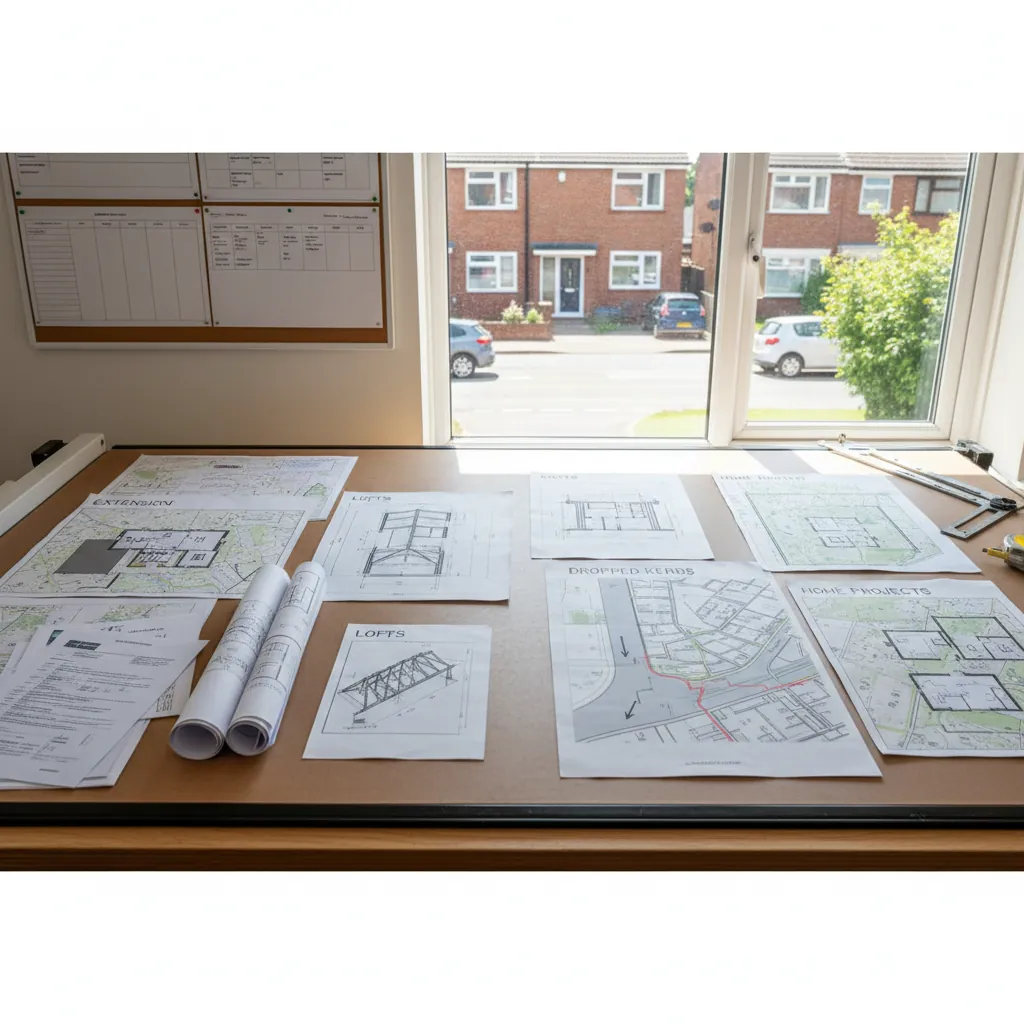
Quick matrix: what should you buy for each project?
Garden Rooms and Outbuildings
For detached garden offices, summerhouses, gym studios, or workshops:
- Under permitted development, any outbuilding within 2 metres of a boundary must have a maximum overall height of no more than 2.5 metres.
- The total ground area covered by buildings (other than the original house) must not exceed 50% of the total curtilage.
A precise 1:500 block plan clearly demonstrates compliance with these boundary setbacks and ground coverage ratios.
Loft Conversions: Class B Volumetric Allowances and Setbacks
When executing a roof alteration or rear dormer under Schedule 2, Part 1, Class B of the GPDO 2015, councils scrutinize your block plan and roof drawings for mathematical compliance:
1. Volume Calculation Limits
The total additional roof volume created by dormers, roof extensions, and hip-to-gable conversions cannot exceed:
- 40 cubic metres for terraced properties.
- 50 cubic metres for semi-detached and detached houses. Any previous roof extensions carried out by prior owners since 1948 count towards this cumulative volumetric allowance.
2. The 20cm Eaves Setback Rule
Under Condition B.2(b), the edge of any rear dormer must be set back at least 20 centimetres from the original eaves of the house, measured along the roof slope. The dormer face cannot simply extend flush with the existing external wall. While architectural elevations show this vertical setback, your 1:500 block plan roof layout confirms that the dormer does not project beyond the original building envelope.
3. Obscure Glazing and Opening Restrictions
Any new upper-floor window placed in a side-facing wall or roof slope must be:
- Obscure-glazed to Level 4 or 5 on the Pilkington scale.
- Non-opening unless the parts of the window that can open are at least 1.7 metres above the finished floor level of the room.
Outbuildings and Garden Offices: The "Incidental" Rule (Class E)
Garden studios, workshops, and luxury summerhouses are among the most popular home projects, but they carry distinct planning constraints under Class E of the GPDO:
- The Incidental Use Test: Class E permitted development only permits outbuildings that are strictly incidental to the enjoyment of the dwellinghouse (such as a gym, pottery studio, hobby shed, or home office). If an outbuilding is intended for use as primary living accommodation (e.g. an independent bedroom, guest granny annexe, kitchen, or self-contained holiday let), it ceases to be incidental and legally requires full planning permission.
- Height Setbacks to Boundaries:
- If positioned more than 2.0 metres from any boundary: Maximum height is 4.0 metres with a dual-pitched roof, or 3.0 metres for a flat roof.
- If positioned within 2.0 metres of any plot boundary: Maximum overall height cannot exceed 2.5 metres from highest ground level.
- Annotating the exact metric distance (e.g.
2.15m to boundary fence) directly on your 1:500 block plan prevents council enforcement officers from challenging whether the building complies with Class E.
Garage Conversions: Replacement Parking Policies
Converting an existing garage into a habitable living room or study is typically permitted development under Class A, but it frequently collides with local authority parking minimums:
- Loss of Garaged Bays: Many councils, particularly in suburban and rural districts, impose strict planning policies requiring at least two off-street parking spaces for a 3-bedroom dwelling and three spaces for 4+ bedrooms.
- Front Driveway Annotations: If converting the garage removes a required parking bay, your 1:500 block plan must demonstrate that replacement parking can be accommodated on the front driveway. Each replacement bay must measure at least 2.4m x 4.8m of usable hardstanding without blocking public pavements or creating reversing hazards.
Common Homeowner Map Ordering Mistakes
- Ordering the wrong scale: Choosing 1:2500 for a suburban extension (too zoomed out) or 1:200 for a location plan (too zoomed in).
- Submitting without a graphic scale bar: If a council officer views the PDF on a tablet or wide monitor, the graphic scale bar is their only way to calibrate on-screen measurements.
- Using Land Registry title plans as planning maps: Title plans show legal ownership extents but are not drawn to current Ordnance Survey MasterMap accuracy, lack street context, and will be rejected at validation.
- Ordering separate plans from different vendors: This creates mismatched dates, linework variations, and inconsistent boundary coordinates.
Frequently Asked Questions
Do house extensions and loft conversions need the same planning maps?
Yes. Both residential project types require the standard planning map pair—a 1:1250 site location plan to provide street context and a 1:500 block plan to detail site clearances, boundaries, and building footprints.
Do I need planning maps for a dropped kerb application?
Yes. Dropped kerb submissions require a 1:1250 location plan showing the property and street network, alongside a 1:500 or 1:200 block plan illustrating frontage dimensions, pedestrian sightlines, and vehicle turning space.
What planning maps are required for a Lawful Development Certificate (LDC)?
Even though an LDC confirms permitted development rights rather than full planning permission, councils still legally require a 1:1250 location plan and a 1:500 block plan to verify the statutory curtilage of the dwellinghouse.
When do I need CAD files (DWG/DXF) instead of PDF planning maps?
You only need CAD formats if an architect, architectural designer, or structural engineer is using CAD software (AutoCAD, Revit, Vectorworks) to draft technical elevations, floor plans, and construction sections.
Should the red line only outline the extension itself?
No. Drawing the red line only around the new extension footprint is a common error. The red line must outline the entire residential curtilage (the whole property) including driveway access out to the public highway.
What is the safest way to avoid planning map validation rejections?
Order your 1:1250 location plan and 1:500 block plan together from the same licensed Ordnance Survey mapping provider to guarantee matching boundaries, identical scales, and current OS MasterMap linework.
Summary
Whether you are extending your kitchen, converting your loft, or dropping a kerb:
- Prepare a 1:1250 site location plan to identify the property and public road access.
- Include a 1:500 block plan showing building footprints and boundary setbacks.
- Ensure your red-line boundary encloses the whole property curtilage.
- Request DWG vector CAD files if your architect is drafting technical working drawings.
Order your council-compliant residential planning map pack or generate your site location plan today on PlanningMapsUK.