
When you submit a planning application in the UK — whether for a single-storey rear extension, a loft conversion, a new outbuilding, or a full residential development — the very first document the council examines is your site location plan.
Before a planning officer ever looks at the design of your proposal, validation staff check your submission against national and local validation checklists. If your site location plan is missing, drawn at the wrong scale, or lacks a proper red-line boundary connecting to the road, your application will be invalidated on day one.
Here is a straightforward guide to what a site location plan is, what councils legally require, and how to make sure yours passes validation without delay.
Buy a location plan for the application and download a 1:1250 or 1:2500 PDF in minutes.

A site location plan is a mandatory map required for UK planning applications.
Site Location Plan Definition
A site location plan is a map drawn at a metric scale (typically 1:1250 in urban and suburban areas, or 1:2500 in rural settings) that identifies your application site in relation to surrounding roads, buildings, and land parcels.
You will see it referred to under a few common names:
- Location plan
- Planning location map
- 1:1250 site plan
- Red-line plan
The site location plan answers one essential question for the local planning authority: "Where is the proposed development, and what is the full legal boundary of the land involved?"
It is not an architectural drawing. It does not show internal room layouts, wall elevations, or construction details. Those specifics belong on your block plan (often called a proposed site layout) and your architectural elevations.
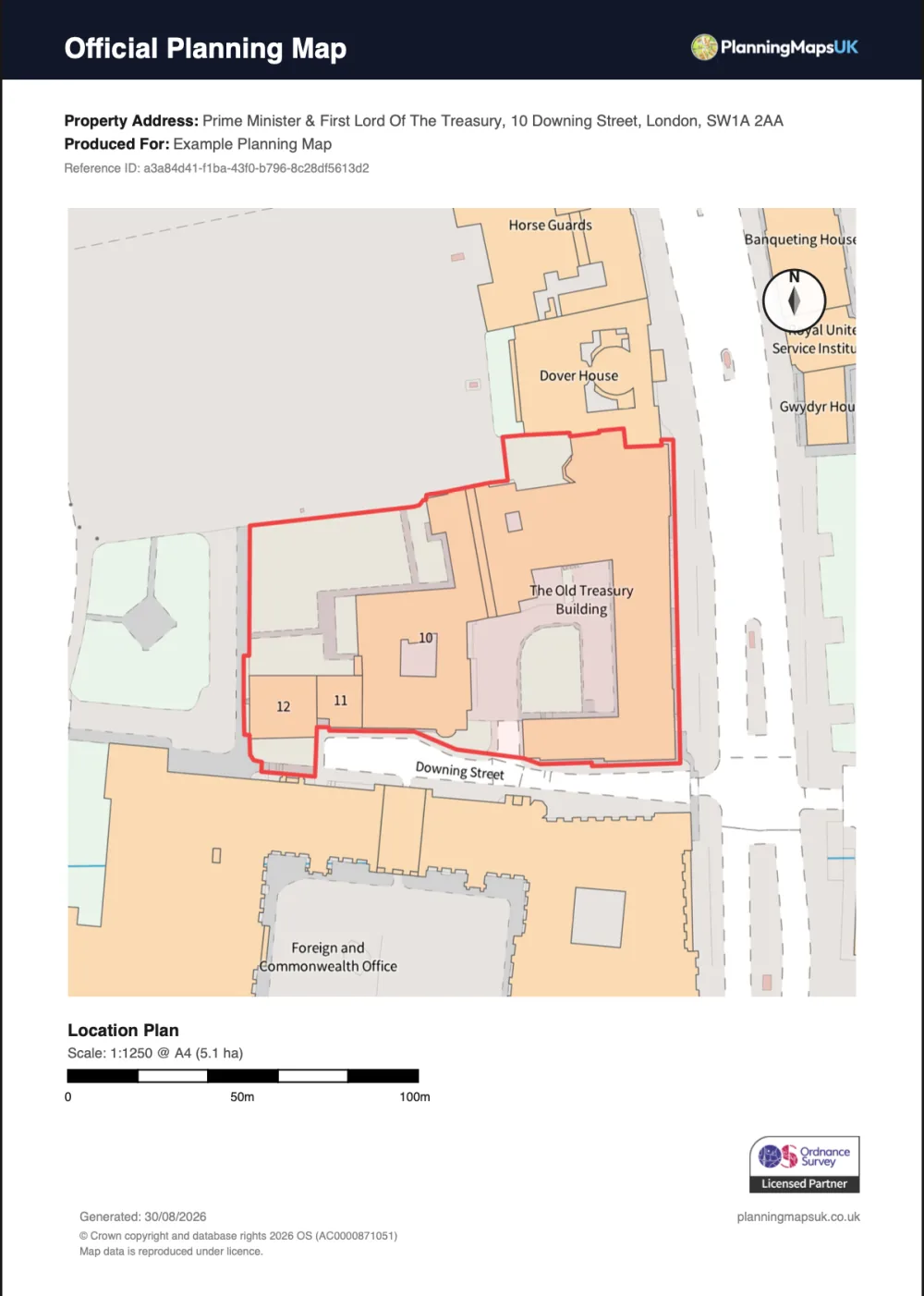
This 1:1250 PlanningMapsUK location plan shows the application land in red together with surrounding roads, buildings, a north point and scale bar.
What Must a Site Location Plan Show?
National Planning Practice Guidance (PPG) sets out clear minimum standards for site location plans. To pass validation, your plan must include:
1. The Application Site Boundary Outlined in Red
Every piece of land needed to carry out the proposed development must be enclosed within a continuous red line. This must include:
- The building or structure being altered or built
- The front, rear, and side gardens or yards
- Any outbuildings within the immediate domestic curtilage
- The access route all the way to the public highway
The access route is where most applicants slip up. If your driveway crosses a private track, shared access road, or verge to reach the adopted council road, that access route must be included within the red line. If you only outline the house footprint or garden, the council cannot grant permission because they cannot verify legal access for construction traffic, waste collection, and emergency services.
Note on shared access: If the access track crosses land owned by someone else, you can still include it in your red line. You will simply need to complete Certificate B on your planning application form and serve notice on the landowner.
2. Other Land Owned or Controlled in Blue
If you own or control any adjoining land next to the application site (for example, a neighbouring field, paddock, or adjacent rental property), you must outline that land with a blue line. This tells the council about your broader landholding without making that extra land part of the formal application.
3. At Least Two Named Roads
Where possible, the map must clearly show at least two named roads. This allows planning officers to locate the property on their central GIS systems and cross-reference nearby planning history.
4. A Clear North Arrow
The plan must feature a directional arrow indicating True North.
5. A Metric Graphic Scale Bar
A printed metric scale bar (showing 1:1250 or 1:2500 measurements in metres) must appear on the plan. This allows planning officers to verify dimensions even if the document is viewed on screen or printed.
6. Licensed Ordnance Survey Data with Copyright Notice
Councils will reject screenshots from Google Maps, Apple Maps, Bing, or open street directories. Your plan must be created from licensed Ordnance Survey MasterMap data and must display a valid Crown copyright statement and OS licence number.
What Scale Should You Use?
Choosing the correct scale depends on the density of the area:
1:1250 Scale (Urban and Suburban)
1:1250 is the standard scale for almost all residential and commercial properties in towns, cities, and suburban neighbourhoods. At 1:1250, 1cm on paper equals 12.5m on the ground. An A4 sheet covers roughly 350m × 250m, which easily captures your property, immediate neighbours, and at least two street names.
1:2500 Scale (Rural Areas and Large Holdings)
For rural properties, farms, equestrian holdings, or isolated woodland, a 1:1250 view might show only open grass with no road junction in sight. In these cases, councils accept or request 1:2500 scale. An A4 sheet at 1:2500 covers roughly 700m × 500m, allowing long private access drives to reach the nearest classified road.
A common trap: Do not submit a 1:2500 map for an urban terraced or semi-detached house. The property will appear too small for the planning officer to assess, and the council will bounce the application back to you.
Site Location Plan vs Block Plan: The Difference
Applicants often mix up these two documents. Here is how they compare:
| Feature | Site Location Plan | Block Plan (Site Plan) |
|---|---|---|
| Standard Scale | 1:1250 (or 1:2500 rural) | 1:500 (or 1:200 detailed) |
| Primary Purpose | Shows where the site sits in the wider area | Shows what is being built on the plot |
| Key Content | Roads, neighbours, access route to highway | Building footprint, proposed extensions, boundaries, trees |
| Required For | All planning applications | Almost all applications involving building works |
A practical way to remember: The site location plan is your neighbourhood zoom-out. The block plan is your plot zoom-in. Most applications require both.

Site Location Plan Definition.
Why Councils Insist on Licensed Ordnance Survey Data
Ordnance Survey MasterMap is the official topographic database used across UK government departments and local planning authorities. When you submit a map built on OS MasterMap:
- The planning officer's digital mapping software can snap directly to your coordinates.
- Council systems automatically overlay statutory constraints: Tree Preservation Orders (TPOs), Conservation Areas, listed building buffers, and Environment Agency flood zones.
- The council avoids copyright infringement. Submitting unlicensed maps from Google or proprietary sources breaches copyright law, and councils are legally obliged to reject them.
Statutory Highway Access: Section 36 of the Highways Act 1980
The most critical requirement of a site location plan is connecting the red-line boundary to a highway maintainable at public expense:
1. Adopted vs Unadopted Roads
Many residential cul-de-sacs, farm lanes, and new-build housing estate roads look like ordinary public roads but are legally unadopted private streets:
- If your driveway connects to an unadopted street, that street is privately owned.
- Under planning law, your red line must continue along the private street all the way to where it joins the nearest council-adopted highway maintainable at public expense under Section 36 of the Highways Act 1980.
- If your red line stops at your property gate on an unadopted lane, the local planning authority will invalidate the application immediately. The council cannot grant permission unless legal access to the public highway network is legally included within the application site.
2. Serving Notice on Private Road Owners
When your red line extends along a private unadopted access road:
- You do not need to own the road to include it in your application.
- However, you cannot sign Certificate A. You must sign Certificate B and serve formal notice (Notice No. 1 under Article 13 of the DMPO 2015) on the owner of the private road (or management company).
- If the owner of the private road is unknown after diligent inquiry, you must sign Certificate C or D and place an advertisement in a local newspaper circulating in the area.
Environmental Constraints and GIS Spatial Screening
When your site location plan PDF arrives at the planning department, technical validation officers extract the spatial boundary and ingest it into their enterprise GIS (such as Idox Uniform, ESRI ArcGIS, or QGIS):
- Automated Buffer Queries: The council GIS automatically runs spatial intersecting queries against statutory environmental datasets:
- Environment Agency Flood Zones 2 and 3: Triggers a mandatory Flood Risk Assessment (FRA).
- Statutory Ecology Sites (SSSI, SAC, SPA, Ramsar): Triggers Natural England consultation.
- Historic England Heritage Assets: Identifies listed buildings within 50m to 100m buffers, Scheduled Monuments, and registered battlefields.
- Tree Preservation Orders (TPOs): Checks whether protected root protection areas (RPAs) intersect the red boundary.
- EIA Screening (2017 Regulations): For commercial or multi-unit residential schemes, the spatial area within the red line is automatically measured against Schedule 2 thresholds under the Town and Country Planning (Environmental Impact Assessment) Regulations 2017. An inaccurate red line can erroneously trigger a costly and time-consuming formal EIA Screening Opinion.
Do You Need a New Location Plan for S73 or Reserved Matters?
Applicants frequently ask whether an existing site location plan can be reused for subsequent applications on the same plot:
- Section 73 Variations (Minor Material Amendments): You must use the exact same red-line boundary as approved in the original parent permission. Under established English case law, a Section 73 application cannot alter or expand the red-line boundary. If you change the red line, the application is ultra vires and void.
- Reserved Matters Applications: Following the grant of outline planning permission, the reserved matters submission must match the outline red line precisely. If you wish to build outside that outline boundary, a fresh full planning application is legally required.
How to Get an OS Site Location Plan in Minutes
You do not need CAD software or an architect just to produce a compliant location map:
- Enter your postcode or address on PlanningMapsUK.
- The platform loads official, live OS MasterMap data centered on your property.
- Draw your red-line boundary around the plot, making sure to carry the line along your driveway to the public highway.
- Select 1:1250 scale and choose your preferred paper size (A4 is standard).
- Download your licensed, print-ready PDF or CAD file immediately.
Every map includes the correct OS licence key, Crown copyright acknowledgement, north arrow, and metric scale bar.
If your council also requires the closer 1:500 plot view, you can generate a matching block plan for planning applications from the same OS dataset.
Frequently Asked Questions About Site Location Plans
What is a site location plan used for?
A site location plan identifies the application site within its wider neighbourhood context. Planning officers use it at the validation stage to pinpoint the property, verify access to the public highway, and cross-reference council GIS constraints like conservation areas and flood zones.
How long is a site location plan valid for?
There is no formal legal expiry date, but local planning authorities expect maps to reflect current ground conditions. If nearby roads, boundaries, or buildings have changed since the map was printed, submit a fresh plan based on up-to-date Ordnance Survey data.
Is a site location plan the same as a Land Registry title plan?
No. A Land Registry title plan shows legal property ownership and general boundaries. A site location plan is a formal planning submission document produced on licensed Ordnance Survey MasterMap data showing the exact red-line planning application boundary.
Do I need a site location plan for a Lawful Development Certificate?
Yes. Applications for Lawful Development Certificates (LDCs) require the same core site location plan as a full planning application to prove the exact location and extent of the property.
Can I use the same site location plan for multiple planning applications?
Yes, provided the red-line boundary accurately reflects the extent of each application and the base map remains up to date. If the works extend to a different area of the site or alter the access route, you must update the red line.
What happens if my site location plan is rejected at validation?
The council will send an invalidation notice explaining what is missing (such as an omitted access route or incorrect scale). Your application will sit on hold until you upload a corrected, compliant plan, delaying your statutory decision period.
Key Takeaways Before You Submit
To ensure your application passes validation smoothly:
- Use 1:1250 scale for urban and suburban properties; reserve 1:2500 for large rural acreage.
- Run the red line to the public highway — never stop at the garden gate or driveway entrance.
- Mark any adjoining owned land in blue so the council understands your full ownership.
- Ensure two named roads are visible within the map boundary where possible.
- Always use licensed OS data with an official copyright statement.
You can create, preview, and download your compliant site location plan now in under five minutes.