
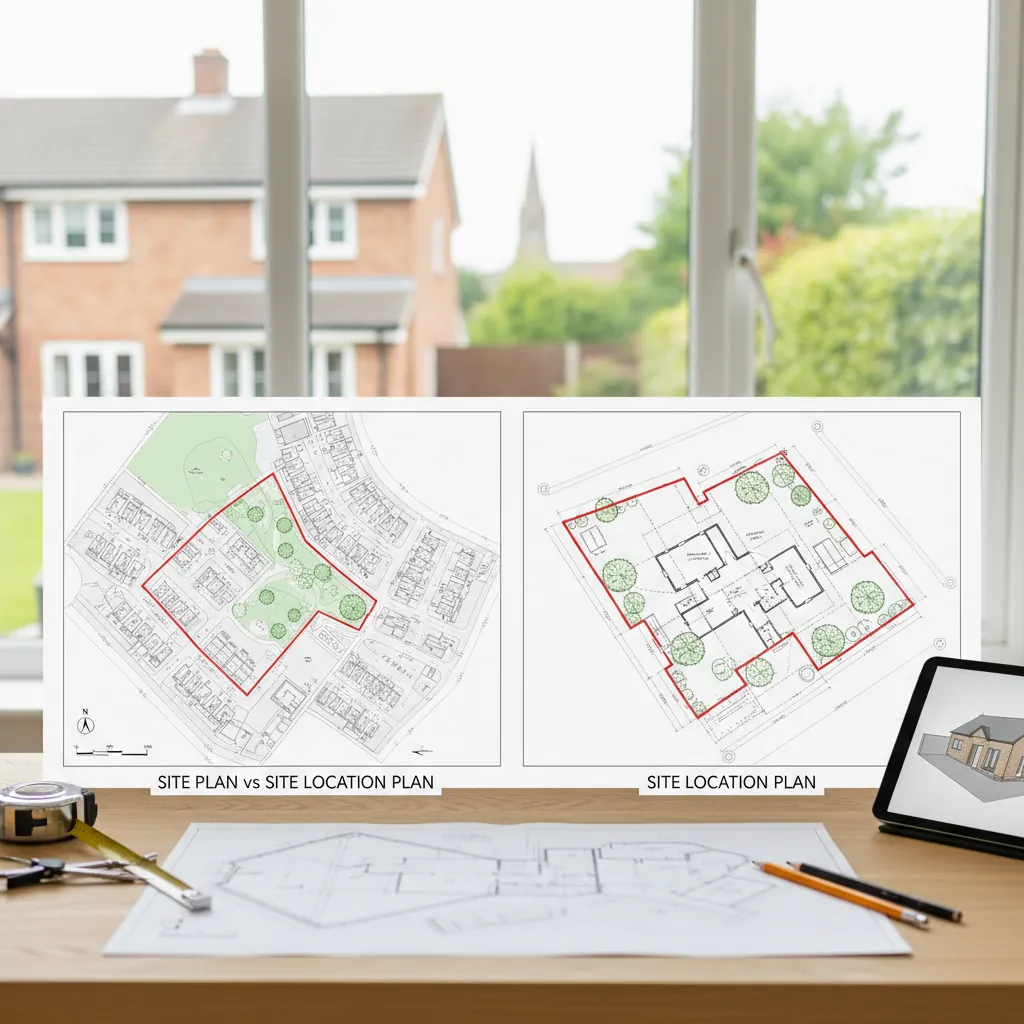
A site plan is a scaled overhead drawing showing a development site, its boundaries, existing buildings, and the position of proposed work. In UK planning it is commonly referred to as a block plan and is normally drawn at 1:500 or 1:200 metric scale.
Terminology across local authorities varies slightly. One council may ask for a "site plan", another for a "block plan", and another for separate "existing and proposed site layout plans". This guide clarifies national statutory standards, acceptable scales, and the exact elements required to pass council validation on your first attempt.
Buy a site plan when the council asks for the drawing. A 1:500 block plan is the same sheet when the validation list uses that name.

Learn what a site plan is in UK planning, how it differs from a site location plan and floor plan, what scale it should be, and how to get one for your planning application.
What Is a Site Plan in UK Planning?
In UK planning practice, a site plan is a detailed overhead drawing that illustrates:
- The application site and its legal curtilage boundaries.
- The existing building footprints on the plot.
- The proposed development (such as a rear extension, outbuilding, garage conversion, or new driveway).
- Physical site features including trees, hedges, walls, fences, and neighbouring structures within close proximity.
It is drawn at 1:500 or 1:200 scale. At 1:500, 1 centimetre on the printed page represents 5 metres on the ground; at 1:200, 1 centimetre represents 2 metres. The appropriate scale depends on the size of the plot, the level of design detail required, and your local council's validation criteria.
The site plan is the "detail" drawing of your submission. It informs the planning officer of the exact clearances between your proposed building work and neighbouring property boundaries.
Site Plan vs Site Location Plan: The Key Differences
These two terms cause frequent confusion for applicants. Here is how they compare:
| Feature | Site Plan (Block Plan) | Site Location Plan |
|---|---|---|
| Standard Scale | 1:500 or 1:200 | 1:1250 or 1:2500 |
| Primary Purpose | Shows what is being built and where | Shows where the land is located in the neighbourhood |
| Key Content | Building footprints, setbacks, garden boundaries, trees | Street names, surrounding houses, road junction access |
| Validation Role | Evaluates neighbour impact, daylight, and amenity | Links the property to the council GIS and legal registry |
The location plan is the wider identification map. The site or block plan is the close-up layout drawing. National planning regulations require a location plan for every application, while local validation checklists specify a block plan for any scheme involving physical building work.
For a comprehensive overview of how all application drawings fit together, see our maps for planning permission guide and our guide on what councils expect from site plans.
Is a Site Plan the Same as a Block Plan?
In practice, yes. Most UK local authorities use the terms site plan and block plan interchangeably on their validation checklists.
However, some planning departments draw subtle distinctions:
- Block Plan: Often refers to the scaled base map showing existing building outlines and site boundaries at 1:500.
- Existing Site Plan: Shows the property footprint, driveway, and garden layout as they exist today.
- Proposed Site Plan: Overlays the new extension, outbuilding, or altered access onto the existing plot with written metric dimensions.
- Site Layout Plan: Typically refers to larger housing developments showing estate roads, service strips, parking courts, and public open space.
Site Plan vs Floor Plan
Another common point of confusion:
- Site Plan: An aerial, bird's-eye view of the entire property curtilage. It illustrates building footprints relative to garden fences and neighbouring houses.
- Floor Plan: A horizontal cross-section looking down inside a building, showing internal room layouts, door swings, and window positions. Prepared by an architect or designer as part of the architectural drawing package.
A complete planning submission requires both: the statutory site plan to position the building on the land, and floor plans to illustrate the internal architectural design.
What Must a Compliant Site Plan Show?
Under UK government guidance and local planning checklists, a valid site plan must include:
Mandatory Elements
- Existing Footprints: All existing buildings and structures accurately positioned.
- Proposed Development: Clearly distinguished using hatching, bold linework, or shading.
- Plot Boundaries: Clear boundary lines with setback measurements from proposed walls.
- North Arrow: Orienting the drawing to True North.
- Metric Scale & Scale Bar: Clear statement (e.g. "Scale 1:500 at A4") accompanied by a calibrated graphic scale bar.
- Licensed Base Mapping: Official Ordnance Survey MasterMap linework with valid Crown copyright.
Additional Features Often Requested
- Positions and species/canopy spreads of trees on or adjoining the site.
- Existing and proposed driveway access, parking spaces, and dropped kerbs.
- Heights and materials of boundary walls, fences, and hedges.
- Adjoining neighbouring buildings within 10 to 15 metres of the proposed work.
Site Plan Scale: 1:500 vs 1:200
- 1:500 Scale: The standard choice for most suburban and rural properties. It neatly displays the house, front and rear gardens, and neighbouring building edges on a single A4 or A3 sheet.
- 1:200 Scale: Recommended for compact urban sites, tight terraced plots, or complex dropped kerb and visibility splay layouts where fine measurement detail is paramount.
What Is a Site Plan in UK Planning?
How to Obtain a Site Plan for Your Property
Historically, preparing a site plan required commissioning an on-site measured land survey. Today, property owners and professionals can obtain licensed digital base plans in minutes:
- For Direct Planning Portal Submission:
Use PlanningMapsUK's online site plan generator. Enter your postcode, select 1:500 or 1:200 scale, draw your application boundary, and instantly download a council-ready PDF. - For Architectural Drafting (AutoCAD / Revit):
Order CAD planning maps in DWG or DXF vector format. Architects can import the OS MasterMap linework directly into their CAD workspace and draft proposals onto verified coordinates. - Drafting Proposals:
You can sketch proposed extension dimensions onto the downloaded PDF base map, or have your architectural designer overlay the proposed building lines.
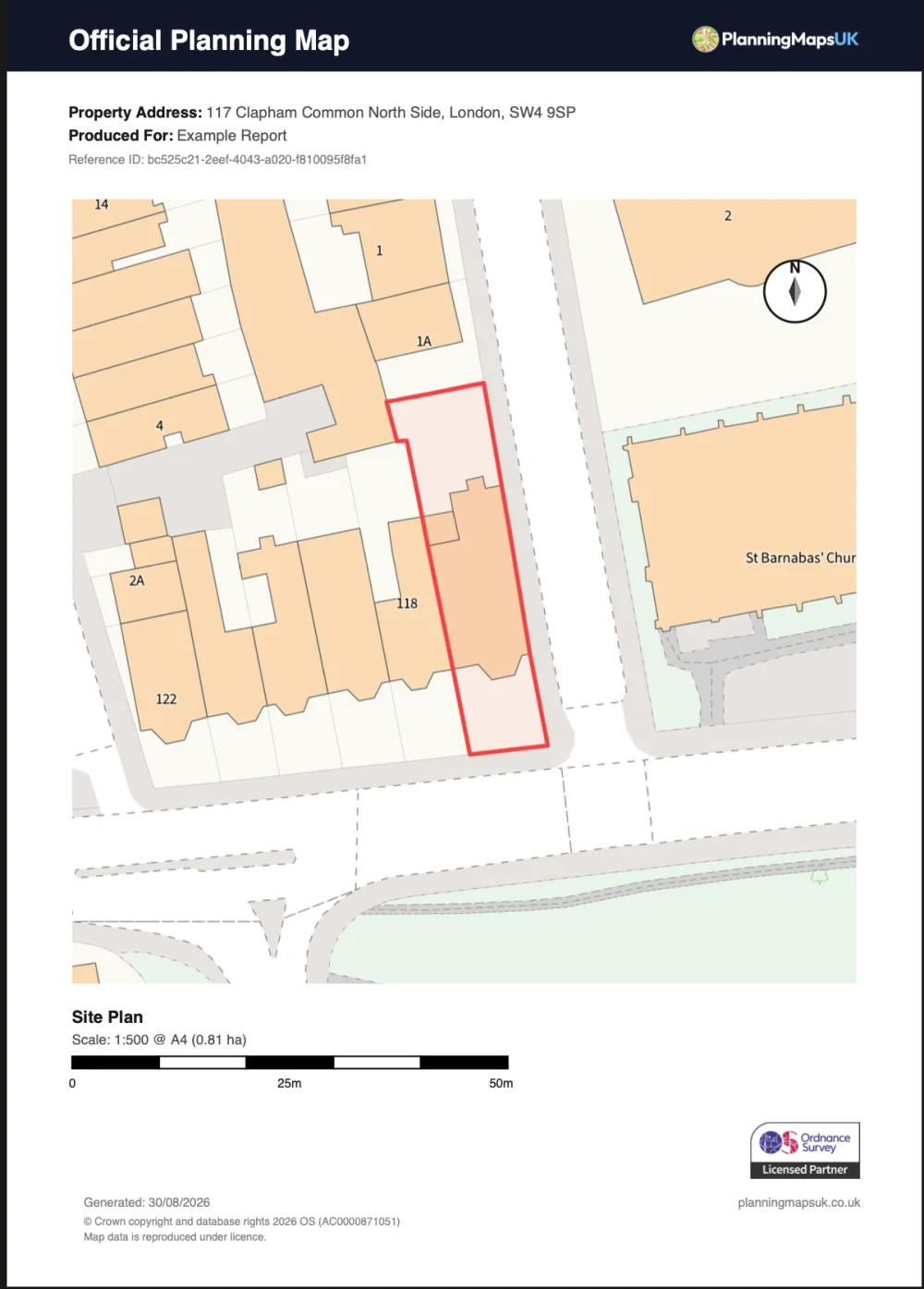
PlanningMapsUK 1:500 site plan example showing the application property, surrounding map detail, north arrow, scale bar, and red-line boundary.
Frequently Asked Questions
What is a site plan in UK planning?
A site plan (often termed a block plan) is a scaled overhead drawing showing a development plot, its legal boundaries, existing structures, and the precise footprint and dimensions of proposed building works. For UK applications, it is typically drawn at 1:500 or 1:200 metric scale.
What scale should a site plan be?
Most local planning authorities require a site plan or block plan at 1:500 scale for residential properties, or 1:200 for tight urban plots and detailed access designs. This is distinct from the 1:1250 location plan.
Is a site plan the same as a location plan?
No. A location plan (1:1250 or 1:2500) shows the property in its wider street context with surrounding roads. A site plan (1:500 or 1:200) zooms into the property itself to show building footprints, boundaries, and garden dimensions.
Is a site plan the same as a block plan?
In UK planning practice, local authorities often use the terms interchangeably on validation checklists. A block plan generally focuses on the relationship between buildings and boundaries, while a detailed site plan may also show hard landscaping, levels, and drainage runs.
What is the difference between an existing site plan and a proposed site plan?
An existing site plan illustrates the plot as it currently stands before any building work begins. A proposed site plan illustrates the intended development, highlighting new extensions, outbuildings, or altered access points.
Can I draw my own site plan?
Yes, provided you start with a licensed, accurately scaled Ordnance Survey MasterMap base, mark True North, include a metric scale bar, and draw proposed walls with precise metric measurements to boundary lines.
Can I use a free satellite screenshot as a site plan?
No. Free satellite or aerial mapping tools (like Google Earth) distort linear scales, lack calibrated metric measurement bars, and are unlicensed for statutory planning submissions.
Summary
A council-approved site plan provides planning officers with the exact measurements needed to assess your development:
- Use 1:500 scale for standard residential plots or 1:200 for compact urban schemes.
- Clearly differentiate between existing footprints and proposed works.
- Always include an official Ordnance Survey MasterMap base, metric scale bar, and True North arrow.
- Pair your site plan with a 1:1250 site location plan to complete your statutory mapping submission.
Daylight and Sunlight Assessment: The BRE 45-Degree and 25-Degree Rules
When assessing whether an extension will cause unreasonable loss of light to adjoining neighbours, case officers apply the standards published in Building Research Establishment (BRE) Report BR 209 (Site layout planning for daylight and sunlight: a guide to good practice):
1. The 45-Degree Horizontal Test on the Site Plan
For single- or two-storey rear extensions:
- The officer identifies the centre point of the nearest ground-floor habitable room window (living room, dining room, kitchen, bedroom) of the neighbouring property.
- A 45-degree angle line is projected from that window centre across the boundary towards your proposed extension.
- The Rule: If your proposed extension crosses both the 45-degree line on the horizontal site plan and the 45-degree line on the vertical elevation drawing, the development is deemed to cause unacceptable daylight deprivation and will be refused or require redesign.
2. The 25-Degree Opposite Obstruction Test
Where new two-storey structures are erected opposite neighbouring windows:
- A sightline drawn at 25 degrees to the horizontal from the neighbouring window sill must remain unobstructed by the new roof ridge.
Site Levels and Finished Floor Levels (FFLs) Relative to AOD
A standard flat two-dimensional site plan can be dangerously misleading on sloping or undulating sites:
- The Sloping Site Risk: An extension that appears modest on a 2D map might sit 1.5 metres above the neighbour's patio due to natural cross-fall, resulting in severe overlooking or retaining wall pressure.
- Spot Heights and Ordnance Datum Newlyn (ODN): On sloping land, councils require spot heights tied to Above Ordnance Datum (AOD):
- Existing Ground Level (EGL): e.g.
EGL +32.150m AOD - Finished Ground Level (FGL): e.g.
FGL +31.900m AOD - Finished Floor Level (FFL): e.g.
FFL +32.300m AOD
- Existing Ground Level (EGL): e.g.
- Annotating these precise levels on your 1:200 or 1:500 site plan demonstrates to flood risk officers and case workers that surface water will not pool against foundations.
Parking and Cycle Parking Technical Standards on 1:200 Plans
Local highway authorities maintain strict validation criteria regarding on-site vehicle and bicycle parking:
1. Vehicle Parking Bay Dimensions
- Standard Perpendicular Bay:
2.4m × 4.8m(many modern councils now mandate2.5m × 5.0mto accommodate larger SUVs). - Parallel Roadside Bay:
2.0m × 6.0m. - Accessible (Disabled) Bay:
2.4m × 4.8mplus an additional1.2mhatched access aisle along one or both sides and the rear. - Reversing / Aisle Clearance: A standard perpendicular bay requires a minimum clear reversing aisle of 6.0 metres between opposing rows of vehicles.
2. Cycle Parking (LTN 1/20 Standards)
Under the Department for Transport’s Local Transport Note 1/20 (Cycle Infrastructure Design):
- Cycle parking cannot simply be an unmeasured box labeled "shed".
- Ground-anchored Sheffield stands must be spaced at least 1.0 metre apart with a minimum operational clearance of
2.0m × 0.8mper stand.
From Planning Approval to Building Control and Deed Plans
Your site plan continues to serve vital legal and structural functions long after planning permission is granted:
- Building Regulations Approval: Building control surveyors cross-reference the approved site plan to check foul drainage outfalls (Part H), fire appliance distances (Part B5), and ventilation clearances (Part F).
- HM Land Registry Transfers of Part (Form TP1): If you are developing a plot to subdivide and sell off land, the site plan forms the basis of the statutory Transfer Deed Plan, which must comply with HM Land Registry Practice Guide 40.
Create your council-compliant site plan online or order your 1:500 block plan today on PlanningMapsUK.