
When a local planning authority asks for a site plan for a planning application, they are referring to the detailed 1:500 block plan rather than the wider 1:1250 site location plan. This is the document planning officers scrutinize to understand existing plot layouts, boundary clearances, and the exact physical footprint of the proposed development.
This guide outlines statutory council expectations for your site plan, mandatory drawing elements, acceptable metric scales, and how to pass validation on the first attempt.
If you need a validation-ready plan immediately, generate your site plan online, or order a dedicated 1:500 block plan.

What does a council expect from a site plan for a planning application?
What Is a Site Plan in UK Planning Terms?
In UK planning workflows, a site plan and a block plan perform the exact same statutory role: detailing the immediate property curtilage rather than the wider neighbourhood.
The site plan differs fundamentally from the site location plan:
- The Site Location Plan (1:1250 or 1:2500): Establishes the property's position within the local street network so officers can identify the site in council GIS records.
- The Site Plan / Block Plan (1:500 or 1:200): Zooms in to illustrate internal plot geometry, distances to garden fences, access tracks, and neighbour clearances.
Any planning application involving physical construction (such as extensions, outbuildings, loft conversions, or dropped kerbs) requires both documents.
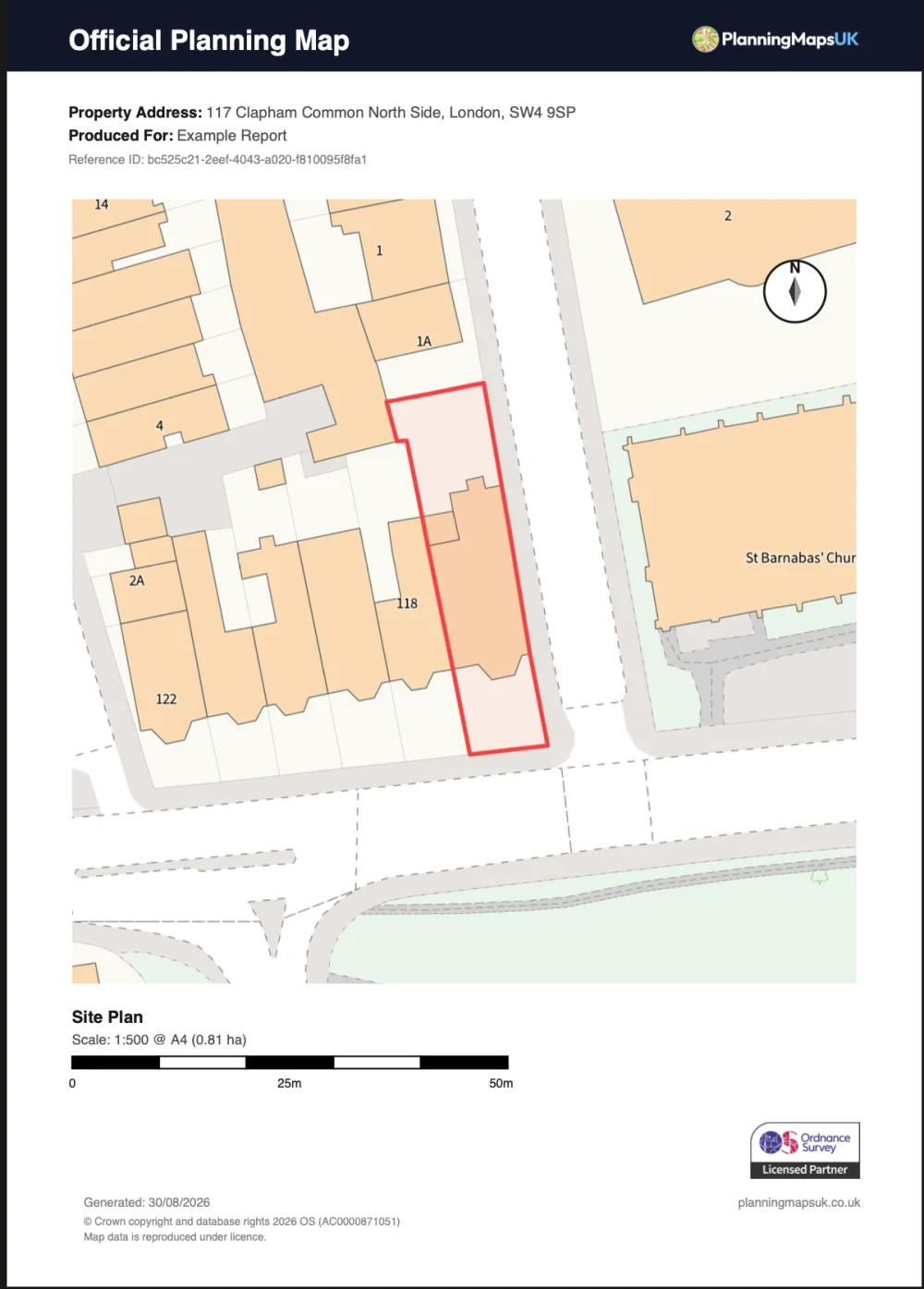
A PlanningMapsUK 1:500 site plan with the property, nearby buildings, roads, red-line boundary, north arrow and scale information visible on one sheet.
What Must a Council-Compliant Site Plan Show?
While individual council validation requirements vary slightly, planning officers universally inspect the following core details:
- The Application Boundary: A continuous, unbroken red line defining the property curtilage and vehicle access to the adopted highway.
- Existing Building Footprints: Accurate outlines of existing structures, outbuildings, and neighbouring walls.
- Proposed Development: Clearly distinguished from existing structures using bold outlines, cross-hatching, or contrasting shading.
- Boundary Measurements: Metric setback distances measured from the outermost faces of proposed walls to property fences and neighbouring structures.
- Access and Parking: Driveways, dropped kerbs, turning heads, and on-site parking bays.
- Physical Site Features: Mature trees (including canopy spreads), hedges, retaining walls, and public rights of way.
- Statutory Elements: A prominent True North arrow, a calibrated metric scale bar, and an official Ordnance Survey Crown copyright licence.
Which Scale Should You Select: 1:500 or 1:200?
- 1:500 Scale: The standard statutory requirement for 90% of UK householder planning applications. It comfortably displays the house, front driveway, rear garden, and neighbouring building edges on a single A4 or A3 sheet.
- 1:200 Scale: Requested by some authorities for compact terraced properties, narrow infill plots, or detailed access/visibility splay drawings where close-up measurement precision is critical.
Statutory Framework: National vs Local Validation Lists
Understanding why councils ask for specific site plan elements requires looking at the legal framework governing UK planning submissions:
- National Statutory Requirements (DMPO 2015): Under Article 7 of the Town and Country Planning (Development Management Procedure) (England) Order 2015 (and equivalent Scottish and Welsh statutory instruments), every planning application must include a plan identifying the land to which the application relates, drawn to an identified metric scale and showing the direction of North.
- Local Validation Checklists (LVC): Under Section 62 of the Town and Country Planning Act 1990, Local Planning Authorities (LPAs) publish local lists setting out additional information required to register an application. While national rules mandate the site location plan, local validation lists determine whether you must provide a 1:500 or 1:200 block plan, tree survey overlays, or surface water drainage markings.
Because councils refresh their local validation lists every two years under government guidance, requirements can differ significantly between adjoining boroughs. For example, one London borough may demand bicycle and refuse storage dimensions marked directly on the 1:500 block plan, while an adjoining rural district council focuses primarily on visibility splays, agricultural track passing bays, and livestock clearances.
Detailed Dimensions and Annotations: What Case Officers Calculate
Planning officers do not simply glance at your site plan; they run specific spatial calculations directly from the scaled drawing to evaluate planning policy compliance:
- Separation Distances and Flank Wall Clearances: Officers check the physical gap between your proposed side extension and the plot boundary. Many local plans enforce a minimum 1.0-metre or 1.2-metre gap between flank walls and boundaries to prevent a "terracing effect" along semi-detached and detached suburban streets.
- The 45-Degree and 25-Degree Daylight Tests: Case officers apply the Building Research Establishment (BRE) daylight guidance by drawing a 45-degree angle from the midpoint of neighbouring habitable ground-floor windows. If your proposed extension footprint on the 1:500 block plan breaches this line, the officer will likely flag loss of light or overshadowing.
- Vehicle Parking and Manoeuvring Standards: Highway authorities require standard residential parking bays to measure at least 2.4 metres wide by 4.8 metres long (often increasing to 3.0m x 6.0m when flanked by walls or fences, or 3.3m wide for disabled spaces). If your proposal removes existing parking spaces, the site plan must demonstrate that replacement bays fit cleanly within the red line without forcing vehicles to reverse into busy distributor roads.
- Bin and Cycle Storage Details: Modern planning approvals require designated refuse storage. For terraced properties or side extensions that eliminate external garden paths, the site plan must illustrate where domestic wheelie bins will be stored and how they will be moved to the highway on collection day without being dragged through habitable rooms.
Trees, Levels, and Surface Water on the Site Plan
On sensitive sites or properties adjacent to mature vegetation, validation teams routinely reject site plans that fail to acknowledge landscape features:
Trees and Root Protection Areas (RPAs)
If mature trees stand within 15 metres of your proposed works (whether on your plot, in council verges, or inside neighbouring gardens), the site plan must show:
- The exact trunk position and estimated canopy spread.
- The Root Protection Area (RPA) calculated in accordance with British Standard BS 5837:2012 (Trees in relation to design, demolition and construction).
- Any proposed protective fencing or ground protection zones during construction.
Failing to mark an adjacent protected tree or one covered by a Tree Preservation Order (TPO) is one of the most common causes of validation halts.
Levels and Sloping Sites
If your site slopes or you propose changing ground levels, a flat 2D footprint is insufficient. The site plan should record:
- Existing ground levels across the plot.
- Proposed finished floor levels (FFLs) relative to a known fixed benchmark (such as an Ordnance Survey bench mark or a manhole cover).
- Retaining walls, terraced landscaping, and step arrangements.
Sustainable Drainage (SuDS) and Run-off
Local authorities increasingly demand evidence that roof water and driveway run-off will not overwhelm municipal sewers:
- Indicate permeable paving materials on proposed driveways and patios.
- Mark rainwater harvesting butts, soakaways, or rainwater attenuation crates, ensuring they maintain the statutory 5-metre minimum building setback required under Building Regulations Part H.
Common Border and Curtilage Pitfalls
Special plot configurations require heightened care when drafting the 1:500 site plan:
| Scenario | What the Site Plan Must Show | Avoid This Common Mistake |
|---|---|---|
| Flats & Converted Buildings | The exact flat unit outline, shared communal grounds, designated parking bay, and bin store. | Drawing the red line around the entire block without identifying the individual leasehold unit. |
| Shared Access Drives | The private driveway in red (or blue if owned by you), indicating right of way widths and turning heads. | Cutting off the red line at the start of your private drive, leaving no connection to the public highway. |
| Public Rights of Way (PRoW) | Any public footpath, bridleway, or byway crossing or adjoining the site clearly labelled. | Omitting public footpaths that cross agricultural holdings or rural curtilages. |
| Listed Building Settings | Existing boundary walls, historic brickwork, outbuildings, and curtilage-listed structures. | Showing modern boundary lines without identifying historic boundary treatments. |
The Four Validation Checks Councils Perform
Before passing your application to a case officer, the validation team verifies:
1. Is the Site Boundary Complete?
Does the red line encompass all land needed to carry out the development, including the private driveway connecting to the council-maintained public road?
2. Is the Proposal Unambiguous?
Can the officer instantly distinguish between existing walls and proposed alterations without guessing?
3. Does the Map Calibrate Accurately?
Does the drawing state a recognised metric scale, and does the metric scale bar match digital screen measurements?
4. Is the Boundary Identical Across the Entire Submission?
Does the red line on the 1:500 site plan match the red line on the 1:1250 location plan down to the millimetre?

What is a site plan in planning terms?
PDF vs CAD for Site Plans
- Choose PDF: If you are uploading directly to the Planning Portal and only need council-compliant presentation documents.
- Choose CAD (DWG / DXF): If your architect, structural engineer, or planning agent is drafting design elevations and construction drawings inside AutoCAD or Revit. Our CAD planning maps provide layered vector linework ready for immediate import.
Frequently Asked Questions
What does a council expect from a site plan for a planning application?
Councils expect a scaled 1:500 or 1:200 drawing showing the full application boundary in red, existing building footprints, proposed works clearly distinguished by shading or hatching, distances to plot boundaries, driveway access, and a True North arrow with a calibrated metric scale bar.
Is a site plan the same as a block plan?
Yes. In UK planning validation checklists, the terms "site plan" and "block plan" are used interchangeably to describe the detailed 1:500 or 1:200 layout drawing that accompanies the wider 1:1250 site location plan.
What scale should a site plan be for a UK planning application?
Most local authorities require 1:500 scale for standard residential developments and extensions. A 1:200 scale may be required for compact urban sites, tight boundary clearances, or complex access arrangements.
Can I draw my own proposed site plan?
Yes, provided you overlay your proposal onto an official licensed Ordnance Survey MasterMap base, maintain strict metric proportions, and include clear measurements from new walls to site boundaries.
Why do councils invalidate site plans?
Common reasons include failing to distinguish proposed walls from existing structures, omitting distance measurements to boundaries, using unlicensed map bases, or submitting a site plan boundary that conflicts with the 1:1250 location plan.
Summary
When preparing your site plan for council submission:
- Select 1:500 scale for standard properties or 1:200 for compact urban plots.
- Clearly differentiate proposed building footprints from existing structures with hatching or shading.
- Include metric setback dimensions to site boundaries.
- Ensure the red-line boundary matches your 1:1250 location plan identically.
Generate your council-compliant 1:500 block plan or order your complete site plan today on PlanningMapsUK.