
If your council validation letter asks for a "Block Plan" and you are unsure what is expected, you are in good company. Terminology varies across UK local authorities: some planning departments call it a block plan, others ask for a site layout plan, a proposed block plan, or simply a 1:500 plan.
Regardless of the label your council uses, they all mean the same core document: the detailed, large-scale map showing exactly what you propose to build and how it relates to your property boundaries and neighbouring buildings.
Here is a clear breakdown of what a block plan must show, which scale to use, and how to avoid common validation rejections.
Buy a block plan for the application, and pair it with a location plan when the council also wants the wider map.
For larger sites or multi-unit schemes, take a look at our site layout plan guide to understand when councils expect supplementary layout drawings.
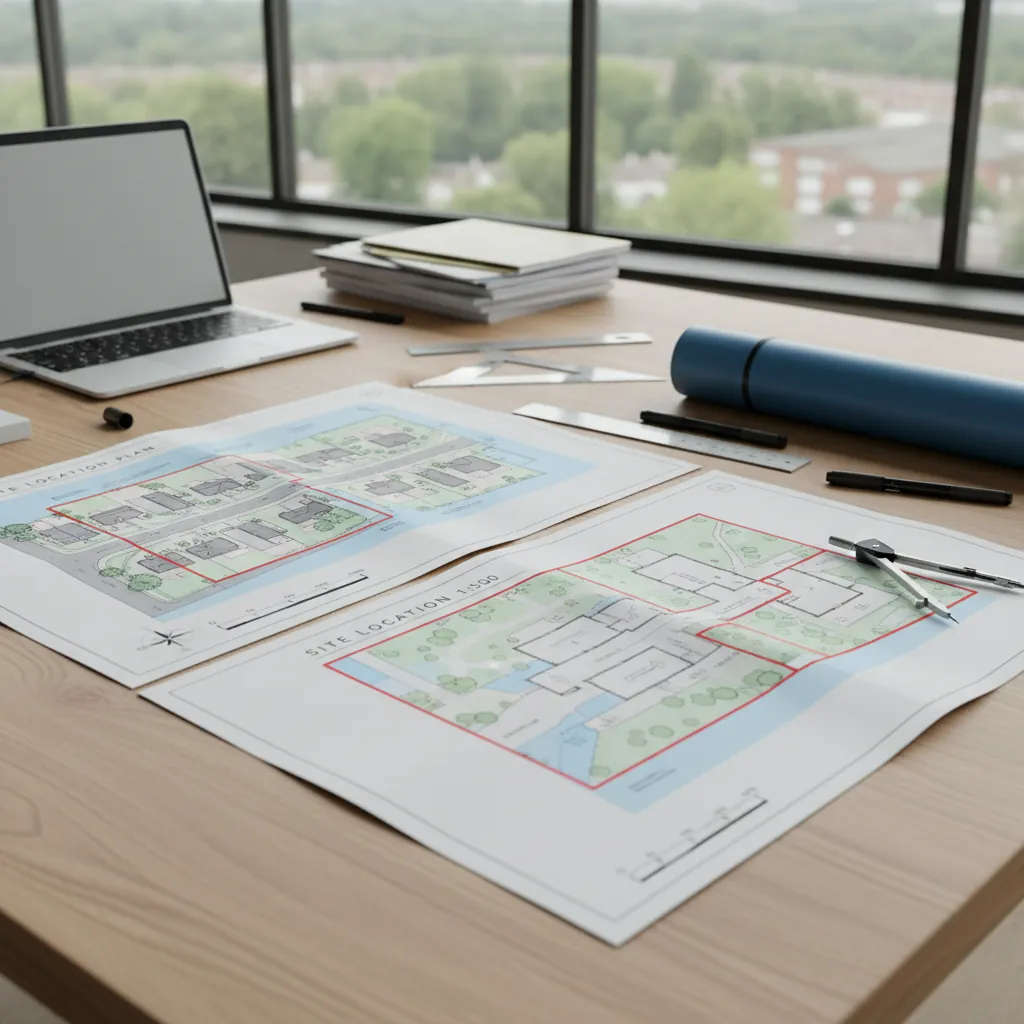
A block plan is the detailed 1:500 map needed for UK planning applications.
Block Plan Definition
A block plan is a large-scale map (drawn at 1:500 or 1:200) that focuses closely on the application plot. While the site location plan zooms out to place your property in its neighbourhood context, the block plan zooms in to provide an accurate aerial snapshot of the development.
A compliant block plan shows:
- The existing building footprint and position on the site
- The proposed development (extension, outbuilding, dormer, porch, or new garage)
- Property boundaries (fences, brick walls, hedges, and railings)
- Significant trees and hedges on or immediately adjacent to the plot
- Hardstanding, driveways, turning heads, and patio areas
- Access points connecting the plot to the public road or private lane
In short, the block plan answers: "What does the property look like right now, and what physical footprint will change?"
Block Plan Scale: Why Councils Request 1:500
The standard scale for a UK block plan is 1:500. At 1:500:
- 1mm on paper represents 500mm (0.5 metres) on the ground.
- A standard A4 sheet covers an area of roughly 150m × 100m — ideal for residential plots, domestic gardens, and suburban driveways.
When to Use 1:200 Scale
On tight urban plots — such as central London mews houses, terraced lightwells, or compact commercial properties — planning officers or architects often prefer 1:200 scale (1mm = 0.2m). This provides double the clarity, making it easy to show narrow boundary setbacks, bin stores, cycle storage, and window positions.
Why the Scale Bar Matters
Planning officers rely on digital measurement tools or physical scale rulers during assessment. If your plan is uploaded without a clear metric scale bar and stated paper size (e.g. "1:500 @ A4"), the officer cannot verify whether your extension is 1 metre or 2 metres from your neighbour's fence. That single omission is a leading cause of validation delays.
What a Block Plan Must Show
While exact local requirements can vary slightly between authorities, most council validation checklists require:
Mandatory Elements
- Application site outlined in red: The exact same continuous boundary line used on your site location plan.
- The proposed works clearly identified: Usually indicated using cross-hatching, shading, or distinct line weights so the officer instantly sees what is new.
- Existing structures: The main house footprint and any detached sheds, garages, or greenhouses.
- Site boundaries: Positions of all perimeter fences, walls, and hedges.
- Key dimensions: Distances from the new extension walls to the site boundaries and to neighbouring houses (in metres).
- North arrow: A clear orientation point.
- Metric scale bar: With the correct ratio and paper size specified.
- Licensed Ordnance Survey copyright acknowledgement: Including a valid Crown copyright licence notice.
Supplementary Features Councils Frequently Ask For
- Trees and canopies: Any trees within the site or within 10–15 metres of the proposed build, noting whether they will be retained or felled.
- Vehicular access and parking bays: Showing how vehicles enter the site and where required parking spaces sit.
- Footprints of neighbouring buildings: Essential for assessing daylight, overshadowing, and privacy impacts on adjoining properties.
- Drainage and rainwater positions: Especially when building over or near existing sewer easements.
Block Plan vs Site Location Plan
It is easy to confuse these two documents because both show your property from above. Here is how they differ:
| Feature | Site Location Plan | Block Plan (Site Plan) |
|---|---|---|
| Typical Scale | 1:1250 (urban) or 1:2500 (rural) | 1:500 (standard) or 1:200 (detailed) |
| Viewpoint | Wide neighbourhood view | Close-up plot view |
| Core Purpose | Identifies where the site is | Shows what is being altered or built |
| Surrounding Area | Shows at least two named streets | Shows immediately adjoining plots and footprints |
| Shows New Extension | No — only the red-line site boundary | Yes — shows the exact footprint of proposed work |
| Required For | All planning applications | Almost all applications involving physical construction |
For a complete application, you will almost always submit both: the 1:1250 plan satisfies statutory location rules, while the 1:500 plan gives officers the details they need to evaluate the design.

Block Plan Definition.
How to Present Your Proposed Works on the Plan
You do not need an elaborate architectural render to create a valid block plan. Follow these practical drafting standards:
- Keep the base map clean: Start with an official OS MasterMap base so property lines and building outlines are legally accurate.
- Hatch proposed extensions: Use diagonal hatching or a subtle grey tint to mark the new footprint.
- Add setback measurements: Add clear metric dimensions showing the distance from the proposed walls to the nearest side and rear boundaries.
- Label existing vs proposed: Include a small legend or clear text labels: "Existing Dwelling", "Proposed Single-Storey Rear Extension", "Existing Detached Garage to be Demolished".
When Do You Need a Block Plan?
You must supply a block plan for any application involving operational development (physical construction work). Common examples include:
- Single-storey, double-storey, and wrap-around home extensions
- Dormer loft conversions altering the roof profile
- Garden rooms, studios, detached garages, and large sheds
- Dropped kerbs and new vehicular crossovers
- Boundary walls or fences exceeding permitted development heights (1m adjacent to a highway, 2m elsewhere)
- Agricultural barns and rural storage buildings
- New build houses or commercial premises
When Is a Block Plan Not Required?
You typically do not need a block plan for pure change-of-use applications where no building works or exterior alterations are proposed, or for minor advertisement consents. However, always review your local planning authority's local validation list before submitting.
How PlanningMapsUK Delivers Compliant Block Plans
PlanningMapsUK allows you to generate a fully compliant 1:500 or 1:200 block plan in minutes using official Ordnance Survey data:
- Search your address or postcode to load licensed OS MasterMap data.
- Review the plot and draw your red-line boundary.
- Select 1:500 (or 1:200) scale and choose your paper format (A4 or A3).
- Download your print-ready PDF or editable CAD file (DWG/DXF) instantly.
Every plan is generated with current OS Crown copyright licences, metric scale bars, and north markers.
Frequently Asked Questions About Block Plans
Is a block plan the same as a site plan?
Yes. In UK planning practice, the terms block plan, site plan, and proposed site layout are often used interchangeably to describe the detailed 1:500 map showing the building and its immediate boundaries.
Can I draw a block plan by hand?
While some councils historically accepted hand sketches, most local planning authorities now insist on digital plans based on licensed Ordnance Survey MasterMap data to ensure metric scaling accuracy.
What is the difference between a block plan and a floor plan?
A block plan is an overhead map showing the position of buildings, boundaries, and hardstanding on the plot. A floor plan is an architectural drawing showing the interior layout and room dimensions.
Does a block plan need to show neighbouring houses?
Yes. Councils require neighbouring building footprints immediately adjacent to your boundary to be shown so the planning officer can evaluate overlooking, daylight loss, and separation distances.
Should I choose a 1:500 or 1:200 scale block plan?
A 1:500 scale is standard for most residential extensions and garden outbuildings. A 1:200 scale is usually requested on very tight urban plots, constrained city infill sites, or where detailed parking layouts must be demonstrated.
Next Steps for Your Block Plan
Before uploading your block plan to the Planning Portal:
- Ensure the red line matches your 1:1250 location plan exactly.
- Verify that your proposed extension footprint is clearly differentiated from existing brickwork.
- Include metric dimensions to all relevant boundaries.
- Confirm the plan includes an OS copyright attribution, north point, and scale bar.
Technical CAD Lineweights and Hatching Standards (ISO 128 / BS 1192)
Professional architectural technicians draft block plans according to established British and international drawing standards (BS 1192 and ISO 128) to guarantee legibility when printed or viewed digitally by planning technicians:
1. Standard Metric Lineweights
To prevent your block plan from degenerating into an indecipherable blob of solid black ink:
- Red Application Boundary:
0.70mmcontinuous bold line. - Proposed External Walls:
0.50mmcontinuous solid black line. - Existing Retained Walls:
0.35mmcontinuous medium black line. - Demolished Structures:
0.25mmdashed line (HIDDEN2in AutoCAD). - Dimension Lines and Leader Arrows:
0.18mmthin line with closed 3mm arrowheads. - Property Boundaries (Fences/Hedges):
0.25mmdotted or centerline.
2. Standard Hatching Patterns
- Proposed Ground Floor Footprints:
ANSI31(diagonal 45-degree hatching spaced at 2mm intervals). - Proposed Permeable Paving / Hardstanding: Stippled dot pattern (
AR-CONCorAR-SAND). - Demolition Footprints: Crossed hatching (
ANSI37) or a light 20% grey fill.
The Approved Plans Condition: Legal Consequences of Deviating
Once your planning application receives approval, your block plan ceases to be an illustrative diagram and becomes a statutory legal instrument:
- Condition 2 (Approved Drawings): Council decision notices invariably include a standard condition stating: "The development hereby permitted shall be carried out in strict accordance with the following approved plans: Drawing Number / Block Plan Ref..."
- Breach of Planning Control (Section 171A TCPA 1990): If your builder positions your extension 300 millimetres closer to the neighbour's fence than scaled on your approved 1:500 block plan, the build is legally unauthorized:
- Neighbours can report the deviation to Council Planning Enforcement.
- The local authority can serve a Planning Contravention Notice (PCN) or a formal Enforcement Notice requiring works to stop or demanding partial demolition.
- Rectification requires submitting an expensive Section 73 Variation of Condition or a Section 96A Non-Material Amendment.
Tree Root Protection Areas (BS 5837:2012) on the 1:500 Plan
Where mature trees stand within or immediately adjacent to your garden, planning officers will examine your block plan against British Standard BS 5837:2012 (Trees in relation to design, demolition and construction):
- The RPA Radius Formula: Case officers calculate the Root Protection Area (RPA) using the mathematical formula: $$\text{RPA Radius (m)} = \text{Stem Diameter at 1.5m (m)} \times 12$$
- The Construction Exclusion Zone (CEZ): The calculated RPA radius must be plotted as a dashed magenta circle around each tree on the 1:500 block plan.
- If your proposed building foundations or patio slab intrude into this circle, the council will require an Arboricultural Impact Assessment (AIA) specifying hand-dug pile-and-beam foundations or no-dig three-dimensional cell web systems (e.g. Cellweb).
Drainage Hierarchy and Soakaway Siting (Building Regs Part H)
Councils increasingly use block plans to audit compliance with Building Regulations Approved Document H (Drainage and Waste Disposal):
- The Statutory SuDS Hierarchy: Rainwater runoff must be discharged according to strict priority:
- Deep infiltration into ground (soakaway / swale);
- Discharge to an open watercourse;
- Discharge to a dedicated surface water sewer;
- (Last resort) Discharge to a public combined sewer.
- The 5-Metre Rule: If using a private soakaway or crate attenuation cell, it must be annotated on your 1:500 block plan at least 5.0 metres away from any building foundation and 2.5 metres from property boundaries to prevent ground subsidence.
Generate your compliant 1:500 block plan today on PlanningMapsUK for immediate PDF or CAD download.