
A dropped kerb sounds like a small project.
There is no new room. No roof. No extension wall. Just a lower kerb, a driveway, and a better way to get the car off the road.
But from a planning and highways point of view, a dropped kerb is all about access. Where does the property meet the road? What land is being used? Is the frontage clear? How does the proposed crossing relate to the public highway?
That is why maps matter.
If your dropped kerb or driveway access needs a planning application, certificate, or council approval package, the map cannot be an afterthought. It needs to show the site, the frontage, and the access relationship clearly.
Use this checklist before you submit.

Applying for a dropped kerb or driveway access?
First, check whether planning permission is needed
Not every dropped kerb project follows the same route.
You may need permission or approval depending on:
- Whether the road is classified
- Whether you are creating or changing access
- Whether hardstanding is being added
- Drainage and surfacing
- Local council rules
- Highway authority requirements
- Whether the property is listed or in a sensitive area
Some homeowners need planning permission. Some need separate highway approval. Some need both. Some may not need planning permission but still need a licensed contractor and council consent for work to the public highway.
The map requirement depends on the route you are told to follow.
If the council asks for planning maps, the usual pair is a site location plan and a detailed site plan or block plan.
Classified vs Unclassified Roads: The Legal Trigger
The primary legal distinction determining whether you need formal planning permission before dropping a kerb comes from Part 2, Class B of the Town and Country Planning (General Permitted Development) (England) Order 2015 (GPDO):
- Unclassified Roads (Permitted Development): If your home fronts an unclassified residential side road or quiet cul-de-sac, creating a vehicle crossover is generally permitted development. You typically do not need to apply to the local planning department. Instead, you apply directly to your county council or unitary authority highways department for a Section 184 Licence under the Highways Act 1980. Even so, the highways team will still require a scaled 1:500 block plan showing the proposed crossing, street furniture, and driveway dimensions.
- Classified Roads (Planning Permission Mandatory): If the road fronting your property is an A-road, B-road, or classified C-road, Permitted Development rights do not apply. You must submit a full planning application to your Local Planning Authority (LPA) accompanied by statutory 1:1250 and 1:500 planning maps. Once (and if) planning permission is granted, you then make a secondary application for the physical Section 184 highway crossing works.
- Conservation Areas, Listed Buildings, and Article 4 Directions: If your property is within a Conservation Area where front boundary demolition is restricted, or an Article 4 Direction has removed Class B permitted development rights, you must obtain full planning permission regardless of road classification.
Visibility Splays and Sightlines: What Highway Engineers Calculate
When evaluating a dropped kerb planning application, council highways officers inspect your 1:500 block plan for road safety and pedestrian sightlines based on the UK government's Manual for Streets:
The X and Y Visibility Envelope
Highway engineers calculate visibility using two coordinate distances:
- The 'X' Distance (Setback): Measured from the edge of the carriageway back along the centreline of the new driveway. The standard UK domestic setback is 2.4 metres (the position of the driver's eye behind the steering wheel), though tight urban plots sometimes permit a relaxed 2.0-metre setback.
- The 'Y' Distance (Stopping Sight Distance - SSD): Measured along the road carriageway in both directions to the oncoming traffic. For a standard 30 mph urban street, the required 'Y' distance is typically 43 metres. For a 20 mph zone, it is 25 metres.
Front Boundary Heights and Pedestrian Splays
Your block plan must show that nothing obstructs visibility within the critical sight triangle:
- Any front boundary walls, fences, or hedges within the visibility splay must be lowered to a maximum height of 0.6 metres above ground level (or 1.0 metre where no pedestrian footway exists).
- Pedestrian Visibility Splays: At the back of the pavement, officers require a 1.5m x 1.5m or 2.0m x 2.0m clear pedestrian triangle on both sides of the driveway entrance so exiting drivers can see children walking along the footway.
Driveway Hardstanding and SuDS Drainage Rules (Class F)
Creating a dropped kerb is almost always coupled with paving over a front garden to park vehicles. Homeowners frequently fall foul of Part 1, Class F of the GPDO:
- The 5-Square-Metre Threshold: If you pave or surface more than 5 square metres of front garden, the surface must either be constructed of permeable materials (e.g. permeable block paving, gravel grids, or porous asphalt) or designed to direct surface run-off to a porous area (such as a lawn, gravel border, or soakaway within the plot).
- No Uncontrolled Run-Off to the Highway: It is illegal under Section 163 of the Highways Act 1980 to allow rainwater from a private driveway to drain directly onto the public footway or road.
- Annotating Drainage on Your Block Plan: Your 1:500 block plan should clearly note: "Driveway surfaced in porous block paving with ACO drainage channel discharging to an on-site gravel soakaway." Adding this detail reassures both planning and highway officers that Sustainable Drainage Systems (SuDS) rules are satisfied.
Street Furniture and Infrastructure Obstacles
Highway authorities will refuse crossover permissions if the proposed dropped kerb conflicts with existing street assets:
- Street Lighting Columns & Telegraph Poles: Most councils enforce a minimum clearance of 1.0 to 1.5 metres between the edge of a dropped kerb ramp and any street light, telegraph pole, or traffic sign. If an asset falls within your proposed opening, you will be liable for the utility company's relocation costs (which routinely exceed £1,500–£4,000).
- Mature Highway Trees: If a council-maintained street tree is situated near the proposed crossing, the highway arboriculturist will assess the tree's Root Protection Area (RPA). Dropping a kerb within 1.0 to 3.0 metres of a mature tree trunk is frequently refused to prevent root severance.
- Utility Inspection Covers: Water meters, gas valves, and Virgin Media/BT telecoms inspection chambers in the pavement often need upgrading from light pedestrian covers to heavy vehicular-rated ironwork at the homeowner's expense.
Marking these physical features accurately on your 1:500 block plan prevents costly surprises during highway technical vetting.
What the location plan shows
The location plan is the wider context map.
For a dropped kerb, it helps the council identify the property and understand where the frontage sits in relation to the road and surrounding area.
It usually needs:
- A 1:1250 scale for most urban properties
- A clear red line boundary
- A north point
- Enough road and property context to identify the site
- An up-to-date Ordnance Survey base
Do not think of this as "just a map of the house". For access projects, the connection to the road is central.
If the red line stops short of the frontage, the map may fail to explain the very part of the site the application is about.
What the block plan shows
The block plan is where the dropped kerb proposal becomes easier to understand.
It is usually at 1:500 or 1:200 and should show the site in more detail.
Depending on the council's checklist, it may need to show:
- The existing frontage
- The proposed vehicle access
- The driveway or hardstanding area
- The pavement and road relationship
- Site boundaries
- Nearby buildings or features
- Existing access points
- Trees, walls, fences, or other relevant constraints
The block plan does not replace technical construction details. It gives the planning or highways team a clear layout of the site and proposed access.
The red line must tell the access story
The biggest dropped kerb map mistake is drawing the red line around the house and ignoring the access.
For many applications, the red line should include the land needed to carry out the development and access the public highway. If the proposal is about creating access to the highway, the frontage cannot be treated as a side issue.
Imagine a homeowner marking only the house and rear garden because that is their property boundary. The proposed dropped kerb sits outside the marked area. The application then looks incomplete because the map does not clearly include the land where the change is happening.
A better map shows the whole relevant site relationship:
- The house and plot
- The driveway or proposed parking area
- The frontage
- The point where access meets the public highway
If any land is shared, private, adopted highway, or owned by someone else, pause and check. The map can show what is physically involved, but ownership certificates and notices must still be handled correctly.
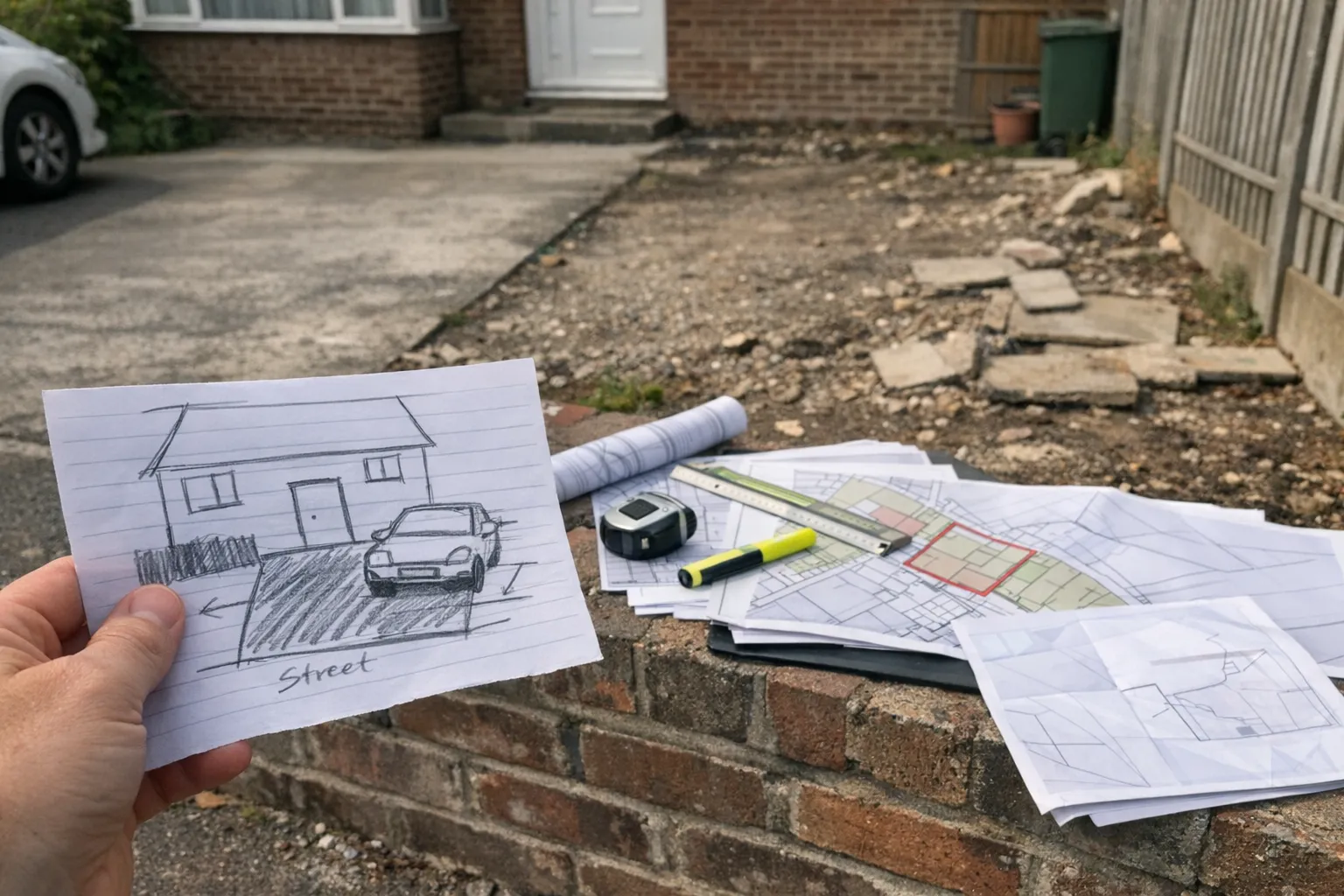
Do not rely on a driveway quote sketch.
Do not rely on a driveway quote sketch
Driveway contractors often prepare useful sketches.
They can show materials, gradients, drainage channels, kerb details, or work areas. Those are useful for construction and pricing.
They are not automatically planning maps.
A planning map needs the correct base, scale, boundary, and site context. A contractor sketch may sit alongside the application, but it should not be mistaken for the location plan or block plan unless it has been prepared to the right standard.
The same applies to annotated screenshots. They might help a phone call. They are risky as formal submission documents.
Access details that often matter
Every dropped kerb project is different, but these questions commonly affect the map and supporting documents:
- Is the property on a bend or junction?
- Is there enough frontage width?
- Are there trees, lamp posts, drains, or street furniture nearby?
- Will a wall, fence, or hedge change?
- Is the surface permeable or does drainage need attention?
- Is there already parking within the plot?
- Does the access cross shared or third-party land?
Not all of these are solved by a map. But a good map helps everyone see the site clearly before those issues are assessed.
Link the map to the cost conversation
Many homeowners start by searching the likely cost of a dropped kerb.
That makes sense. The physical works matter.
But cost and permission are connected. If the application is delayed because the map is wrong, the contractor's price is not the only problem. You can lose time, need revised documents, and have to re-coordinate with the council or highway team.
If you are still budgeting, use the dropped kerb cost calculator. When you move from budgeting to applying, make sure the map pack is ready too.
A practical dropped kerb map checklist
Before submitting, check:
- Is the correct property shown?
- Is the frontage visible?
- Does the red line include the relevant access land?
- Is the map based on suitable Ordnance Survey data?
- Is the scale clear?
- Is there a north point?
- Does the block plan show the proposed access and driveway relationship?
- Do any contractor drawings agree with the planning maps?
Small access projects can still fail on small document problems.
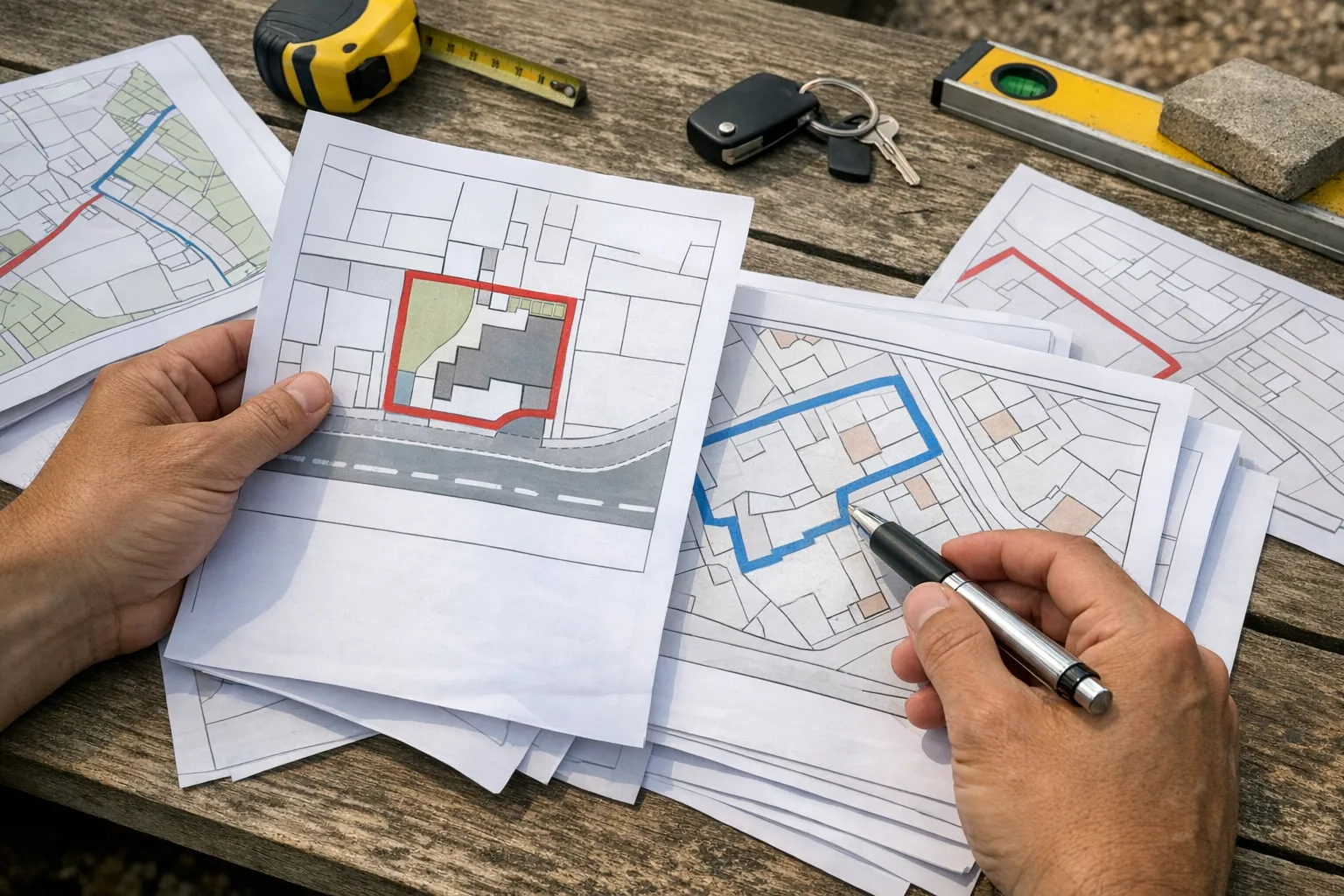
The takeaway.
The takeaway
A dropped kerb is not only a kerb detail. It is a change to how a property connects to the highway.
That is why a clear block plan and site location plan can make the application easier to understand.
Show the site. Show the frontage. Show the access. Keep the red line honest.
Do that, and the council can spend less time working out what land you mean and more time assessing the actual proposal.