
One of the most frequent points of confusion for homeowners and builders applying for planning permission is the requirement for both a Site Location Plan and a Block Plan:
"The council asked for a Site Location Plan and a Block Plan. Don't both maps show my house from above?"
While both documents show your property from an overhead aerial perspective with a red boundary, planning officers use them for entirely different stages of their assessment. Submitting one without the other is one of the most common reasons planning applications are bounced back at the validation stage.
Here is a plain-English explanation of how the two plans differ, which scales to use, and why councils legally require both.
If you already know which map you need, you can order a compliant site location plan or a block plan directly from official Ordnance Survey data.
If you are unsure which package covers your project, use our Which planning map do I need? tool or check scales with our planning map scale chooser.
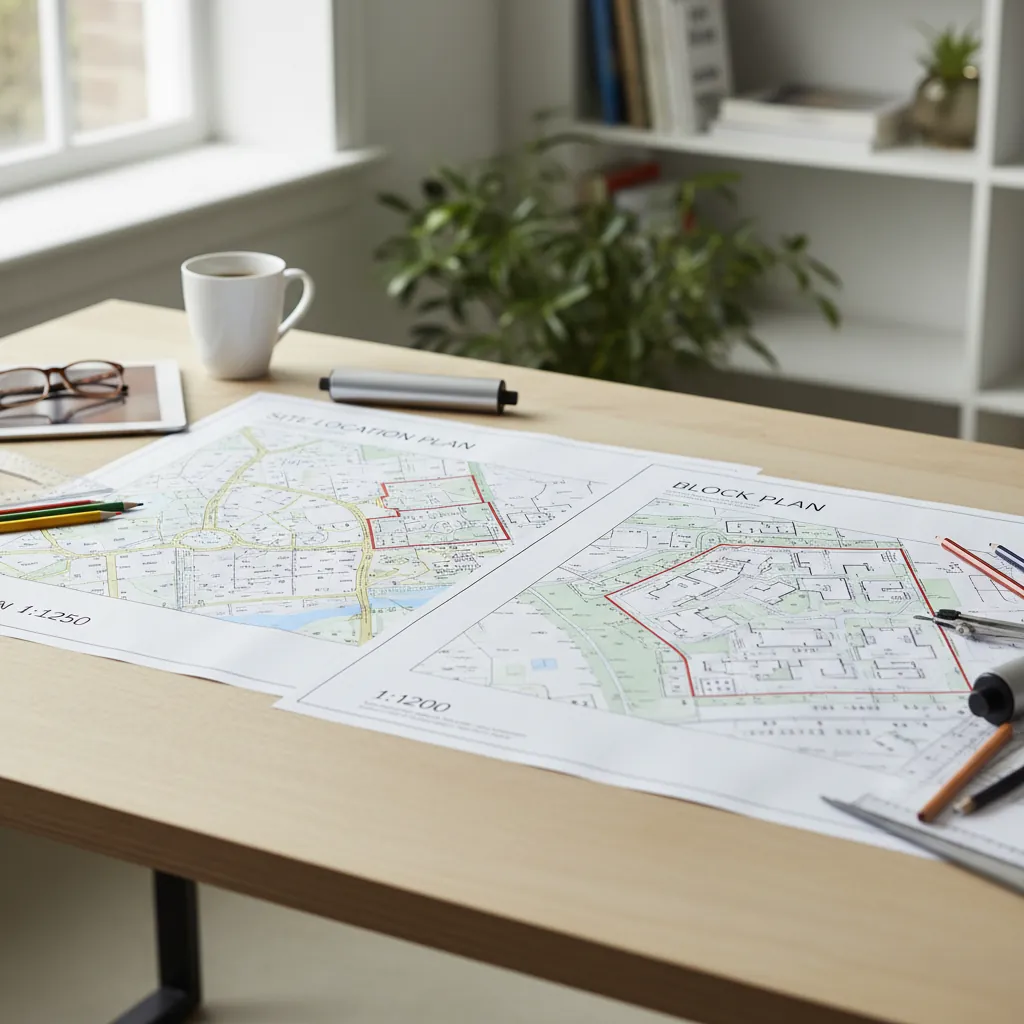
Do you need a Location Plan or a Block Plan?
1. The Site Location Plan (1:1250 or 1:2500)
Think of the Site Location Plan as your "neighbourhood zoom-out".
- Standard Scale: 1:1250 for urban and suburban properties; 1:2500 for rural holdings and farms.
- Primary Purpose: Shows where the site is situated within the wider area.
- Key Content: The application site outlined with a continuous red line (including access to the road), adjoining land owned by the applicant outlined in blue, surrounding houses, and at least two named roads.
- How Councils Use It: Planning validation officers use this map to register the property on their local geographic information system (GIS). It allows them to quickly cross-check statutory designations: Conservation Areas, Green Belt, listed building curtilages, tree preservation zones, and flood risks.
Practical check: If your location plan is so zoomed in that you cannot see the names of at least two nearby streets, it is too tight.
2. The Block Plan (1:500 or 1:200)
Think of the Block Plan (frequently titled a "Site Plan" or "Proposed Site Layout") as your "plot zoom-in".
- Standard Scale: 1:500 for standard residential plots; 1:200 for compact urban sites and complex layouts.
- Primary Purpose: Shows what is being proposed on the property itself.
- Key Content: Existing building footprints, proposed extensions or outbuildings (clearly hatched or shaded), accurate boundary lines (fences, walls, hedges), driveways, parking spaces, and mature trees.
- How Councils Use It: Planning officers use this plan to assess physical impact. They measure precise distances to verify setback depths, check for potential overshadowing of neighbouring windows, and evaluate parking and turning arrangements.
Practical check: If you cannot clearly distinguish the proposed new extension wall from the existing rear wall of the house, your block plan is too zoomed out.
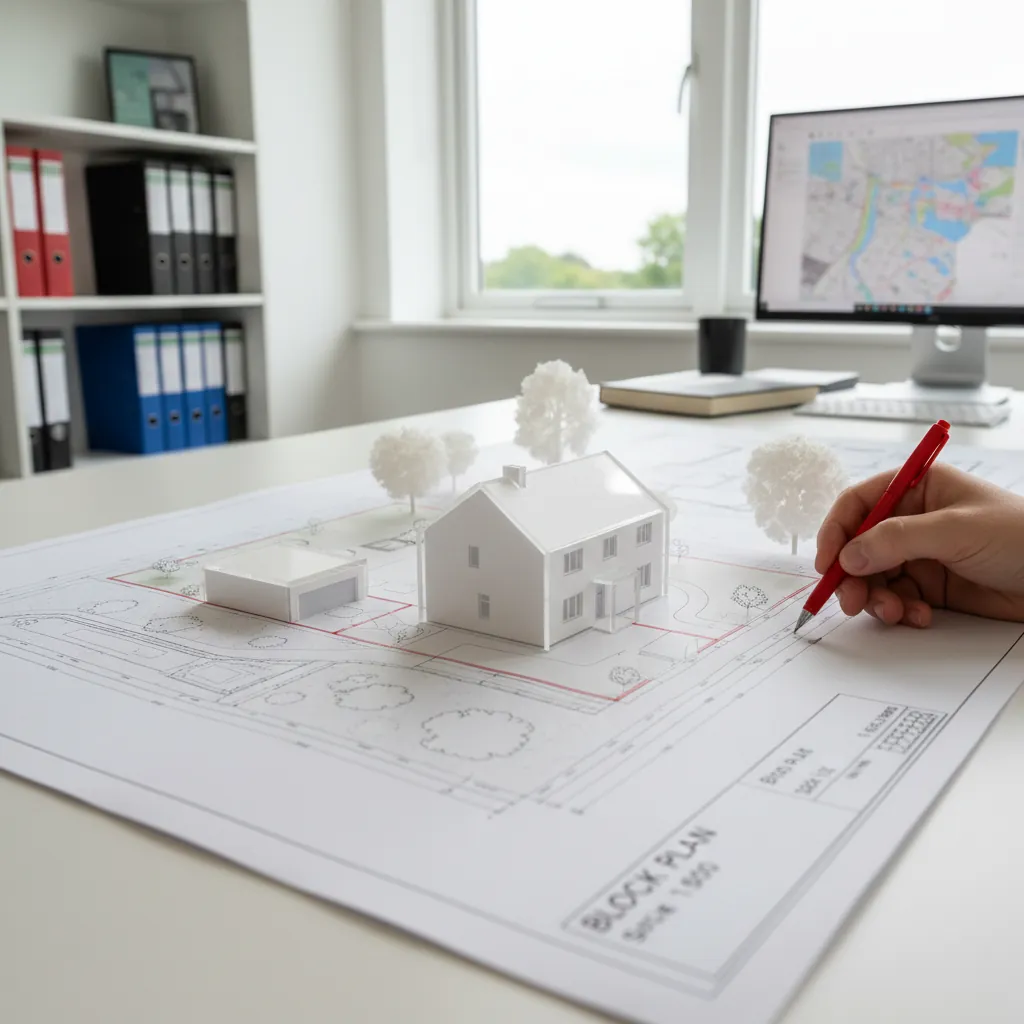
1. The Site Location Plan (1:1250).
Side-by-Side Comparison
| Feature | Site Location Plan | Block Plan (Site Plan) |
|---|---|---|
| Primary Scale | 1:1250 (urban) / 1:2500 (rural) | 1:500 (standard) / 1:200 (detailed) |
| Focus | Wider context (roads, neighbouring parcels) | Plot detail (boundaries, proposed structures) |
| Typical Area | 2 to 5 hectares | 0.05 to 0.5 hectares |
| Main Role | Identification and GIS registration | Design assessment and measurement |
| Red Line Extent | Entire application plot plus highway access | Identical site boundary plus proposed build footprint |
| Mandatory? | Yes, legally required for all applications | Yes, for all operational building works |
A Simple Analogy: Finding the House vs Examining the Build
Consider ordering a parcel delivery versus hiring a structural surveyor:
- The delivery courier needs the postcode and street map to navigate to your road and find your driveway (the Location Plan).
- The surveyor needs a detailed plot drawing showing your boundary lines, where the patio starts, and where the new foundation will sit relative to the garden fence (the Block Plan).
A planning officer carries out both roles: they must first establish statutory jurisdiction over the land, and then evaluate the physical impact of the proposed structure on neighbours.
How Planning Officers Use Both Plans on Physical Site Visits
Understanding how a planning case officer actually uses your plans on site clarifies why both documents are indispensable:
1. The Street Arrival (The 1:1250 Location Plan)
When the planning officer arrives in your neighbourhood for the statutory site inspection:
- They use the 1:1250 Location Plan to assess street-level character, on-street parking congestion, and the relationship between your driveway access and oncoming traffic.
- They verify highway sightlines, check for nearby bus stops or pedestrian crossings, and confirm that your red line accurately reaches the council-maintained adopted highway.
2. The Garden Inspection (The 1:500 Block Plan)
Once the officer steps through to the rear garden, they put away the location plan and pull out the 1:500 Block Plan:
- Equipped with a handheld digital laser measure, the officer measures the physical distance from your existing rear wall to the side fence.
- They cross-check the written setback dimensions against the neighbouring building footprint.
- They visually verify tree canopy spreads and inspect neighbouring habitable windows to confirm that the 45-degree daylight test lines marked on the plan correspond to reality.
If you need to mark existing trees while preparing the drawing, the tree map annotation tool lets you add labelled canopy areas to the planning map and keep that context with the rest of the plan.
If your submission includes only a location plan, the officer cannot measure plot clearances; if it includes only a block plan, the officer cannot verify street context.
Technical CAD Workflow: Managing Both Scales in AutoCAD
For architectural technicians drafting submissions in CAD software, managing the location plan and block plan does not mean maintaining two separate drawing files:
- Single Real-World Model Space (1:1 Metres): The underlying Ordnance Survey MasterMap DWG is inserted once at 1:1 metric scale in British National Grid coordinates. The existing house, proposed extensions, and boundaries are drafted at full real-world size.
- Layout Tab 1 (Site Location Plan 1:1250): An A4 layout viewport is created with the zoom scale set to
0.8xp(1000/1250). Background road layers and street names are turned on; internal extension room walls are hidden or simplified. - Layout Tab 2 (Block Plan 1:500): A second A4 or A3 layout viewport is created with the zoom scale set to
2.0xp(1000/500). Detailed hatching for proposed brickwork, metric setback callouts, and tree canopy circles are displayed.
By linking both layouts to the same underlying model space geometry, any revision to the building footprint automatically updates both the location plan and the block plan simultaneously, eliminating boundary discrepancies.
Dual Access Plots: Dealing with Front and Rear Roads
A complex scenario occurs when a property fronts one road but takes vehicular access from a rear lane:
- The Front Pedestrian / Rear Vehicular Trap: For example, a Victorian terraced house fronting an adopted High Street with a detached garage accessed via a rear unadopted back lane.
- What Must the Location Plan Show? The red line must encompass the house, garden, garage, and both access routes leading to public adopted highways. If vehicular access is taken exclusively from the rear service lane, the red line must follow that rear lane until it connects to an adopted street.
- What Must the Block Plan Show? The 1:500 block plan must detail both the front pedestrian pavement interface and the rear vehicle turning head, ensuring visibility splays are verified for both entry points.
Urban vs Rural Considerations
Urban and Suburban Sites
In built-up areas where plots are closely spaced:
- Location Plan: Always use 1:1250. This scale fits comfortably on an A4 sheet and captures neighbouring streets without losing legibility.
- Block Plan: Use 1:500 for typical detached, semi-detached, or terraced homes. If working on a very tight city infill site where millimetres matter, a 1:200 plan may be requested.
Rural Properties and Smallholdings
In rural areas, properties often have long private driveways, and the nearest road junction may be hundreds of metres away:
- Location Plan: Use 1:2500. At 1:1250, a rural map might show only an empty field with no recognisable roads or landmarks. The 1:2500 view provides the broader view necessary to establish the connection to an adopted highway.
- Block Plan: Keep the block plan at 1:500. Even if the surrounding holding is tens of acres, the barn, outbuilding, or domestic extension still requires the same 1:500 scale for officers to assess its physical footprint.
Can They Be Submitted on the Same Sheet?
Yes, under certain circumstances. If you are submitting large-format architectural drawings (such as A1 or A2 sheets), your architect may position the 1:1250 location plan in an upper corner box and present the 1:500 block plan across the main area.
However, when submitting documents yourself directly through the Planning Portal, uploading two distinct A4 PDFs is the cleanest and most reliable approach:
Site_Location_Plan_1250.pdfBlock_Plan_500.pdf
This guarantees that council validation officers can index each plan under the appropriate portal category without requesting clarification.
Three Common Mistakes That Cause Delays
1. Digitally Zooming In on a 1:1250 Map to Create a Block Plan
Taking a 1:1250 map and cropping or enlarging it to 1:500 results in thick, fuzzy lines and imprecise geometry. Ordnance Survey MasterMap data is layered with different levels of detail depending on the selected scale. Always generate your 1:500 plan from true 1:500 source data.
2. Inconsistent Red-Line Boundaries
The red boundary line on your location plan must correspond identically to the red boundary line on your block plan. If your location plan includes the driveway to the street but your block plan cuts off at the front lawn, the council cannot validate the application due to conflicting site areas.
3. Missing Highway Access on the Location Plan
The red line on your location plan must extend from your property all the way to the public adopted highway. If your property is accessed via a private lane or shared drive, that entire access route must be edged in red.
Frequently Asked Questions
Is a site plan the same as a block plan?
Yes. In UK planning, the terms site plan, block plan, and proposed site layout refer to the same detailed 1:500 or 1:200 map showing the proposed works on the plot.
Do I need a block plan for a Lawful Development Certificate?
Yes. Even under Permitted Development, the planning authority needs to verify dimensional limits (such as rear projection depth and distance to boundaries), which require a 1:500 block plan.
Can I use Google satellite imagery as a block plan?
No. Satellite imagery suffers from perspective distortion, cannot be scaled accurately, and breaches copyright. Councils require licensed Ordnance Survey vector mapping.
Do I need to show trees on the block plan?
Yes. Any mature trees on your plot or within falling distance on neighbouring land must be marked to allow officers to assess potential root protection issues.
Can the location plan and block plan be submitted on the same page?
On large format architectural drawings (like A1 or A2 sheets), architects frequently combine both views. For standard online submissions on the Planning Portal, submitting two separate A4 PDFs is standard practice and makes document indexing simpler.
Summary Checklist
To keep your planning application on track:
- Prepare a 1:1250 Site Location Plan showing two named roads and highway access.
- Prepare a 1:500 Block Plan clearly illustrating your proposed building works and distances to boundaries.
- Ensure the red-line boundary matches exactly across both documents.
- Verify that both maps include Crown copyright licensing, a north arrow, and a metric scale bar.
You can order both documents together using our OS planning map pack for immediate download in PDF or CAD format.