
Buy the block plan for the application. This guide is the checklist a validation officer uses before they accept it.
When you submit plans to your local council, your application first passes through the hands of a planning technician or validation officer. Their job is not to judge the design of your extension or evaluate local objections — their job is strictly to check that every mandatory document meets national and local validation criteria.
The block plan is consistently one of the top causes of validation failure. If the scale is omitted, the base map is unlicensed, or the red boundary fails to match your site location plan, your application will be marked invalid and shelved until you rectify the error.
Here is a practical guide to what councils require on a block plan, the common errors that trigger validation letters, and how to prepare a plan that sails through validation on the first pass.

A complete guide to block plans for planning applications.
Why Your Block Plan Matters Beyond Validation
Beyond passing the initial validation filter, the 1:500 block plan is the working drawing the case officer uses throughout their statutory assessment.
Using your block plan, the planning officer will verify:
- Exact setback distances from new flank walls to neighbouring boundaries.
- Separation distances between your extension and neighbouring habitable room windows (to assess daylight loss and the 45-degree rule).
- Total site coverage and whether the remaining garden space satisfies local design guides.
- The proximity of new foundations to protected or mature tree canopies.
- On-site parking provision and vehicle turning space.
If your block plan is distorted or inaccurate, the case officer may miscalculate these dimensions, leading to unnecessary objections, revision requests, or refusal.
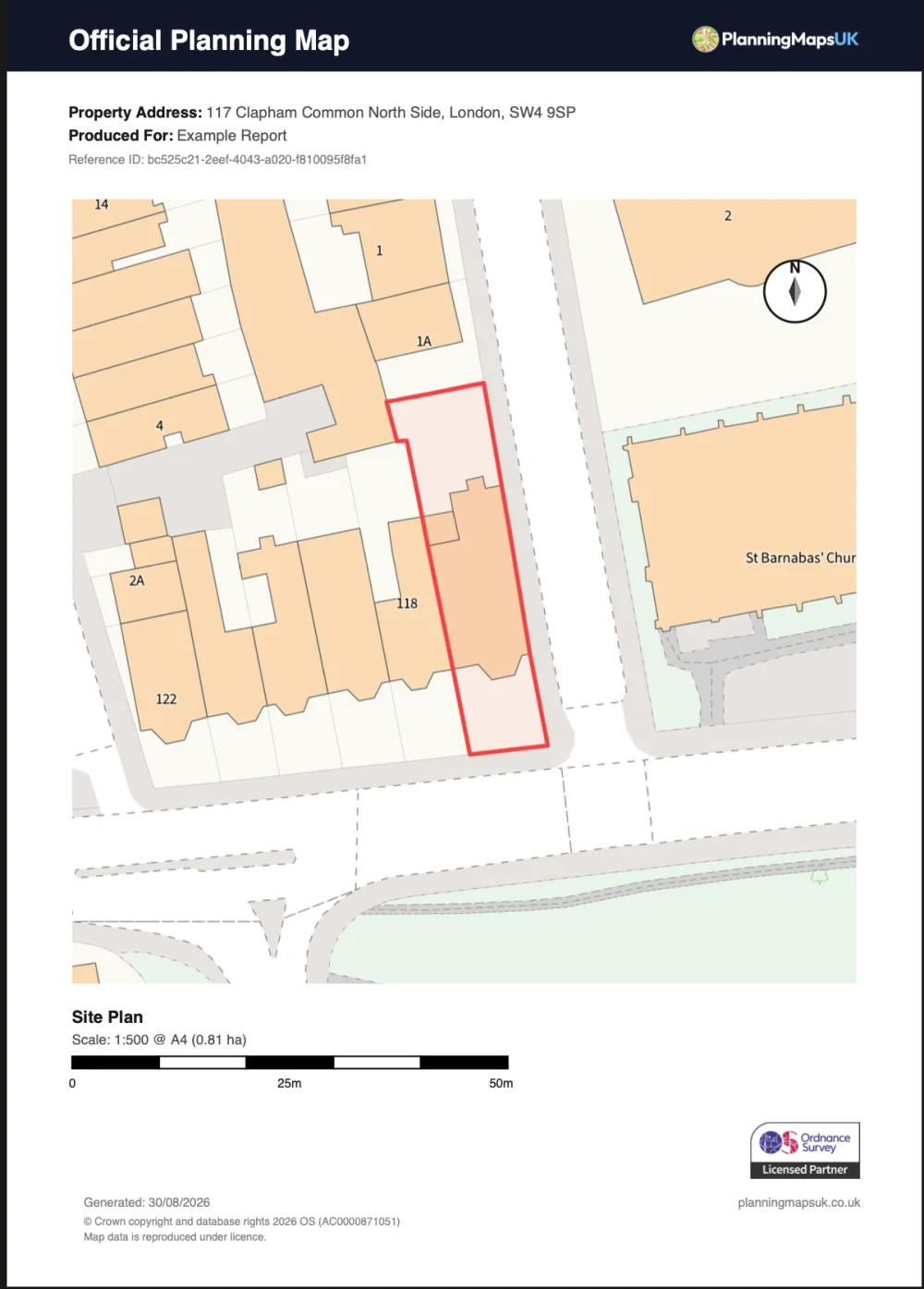
Example PlanningMapsUK block plan showing detailed OS mapping, the application boundary, north point, scale and licensed partner information.
What Must a Block Plan Include?
National Planning Practice Guidance and council validation checklists require the following key features:
Mandatory Baseline Standards
- Accurate Metric Scale (1:500 or 1:200): Most domestic extensions and garden buildings require 1:500. Complex urban plots or tight infill developments often call for 1:200.
- Licensed Ordnance Survey MasterMap Base: The plan must display official Crown copyright statements and an authorised OS licence number. Free web maps and satellite imagery are inadmissible.
- Continuous Red-Line Boundary: Outlining the entire application site, matching your site location plan line for line.
- North Arrow: Orientated accurately to True North.
- Printed Metric Scale Bar: Graphic bar demonstrating metres on the ground, allowing officers to measure dimensions accurately.
- Existing Footprints: Showing the main dwelling and any existing garages, outbuildings, or conservatories.
Showing the Proposed Works Clearly
The new development must stand out clearly from existing brickwork. You can achieve this by:
- Diagonal cross-hatching across the proposed extension footprint.
- A bold, contrasting line weight for new external walls.
- A simple legend: "Existing Building (Grey Outline)" vs "Proposed Extension (Hatched)".
Key Site Features to Annotate
- Boundary Treatments: Annotate fence, wall, or hedge lines with estimated heights (e.g. "1.8m timber close-board fence").
- Neighbouring Properties: Adjoining house footprints must be visible so the officer can assess daylight and overlooking impacts.
- Mature Trees: Mark tree trunk positions and approximate canopy spreads within the site or within 10–15 metres of construction.
- Access and Hardstanding: Driveways, dropped kerb entry points, and permeable patio areas.
Sloping Sites and Finished Floor Levels (FFLs)
On flat suburban plots, a standard 2D block plan footprint is usually sufficient. However, if your site has a gradient or slopes towards a neighbouring boundary, local validation checklists mandate level annotations:
- Spot Heights and Ordnance Datum (AOD): Levels should be referenced to a permanent benchmark or stated as metres Above Ordnance Datum (AOD). The block plan should record existing ground levels at the site corners and along boundary fences.
- Finished Floor Levels (FFL): You must annotate the proposed ground-floor slab level relative to existing ground levels. For example: "Proposed FFL = +104.25m AOD (Existing Ground = +103.80m AOD)".
- Preventing Overlooking and Retaining Walls: Case officers use these level notations to evaluate whether raised patio terraces or elevated ground floors will create unneighbourly overlooking into adjacent private gardens. If retaining walls or garden steps are required to manage ground changes, their location and structural heights must be marked on the block plan.
Integrating Trees: British Standard BS 5837:2012 Overlays
Trees are a frequent flashpoint during planning validation. If mature trees or substantial hedges grow within 15 metres of your proposed foundations, the council's arboricultural officer will review your block plan:
- Root Protection Areas (RPAs): Under BS 5837:2012 (Trees in relation to design, demolition and construction), every retained tree has a mandatory root protection zone calculated as a circle with a radius equal to 12 times the single stem diameter (measured at 1.5m above ground).
- The Tree Constraint Overlay: Your block plan should illustrate the exact trunk position, the crown spread in all four cardinal directions, and the circular RPA boundary.
- Foundation Design: If your proposed extension footprint encroaches within the outer third of a tree's RPA, the block plan must indicate specialized non-invasive foundations (such as pile-and-above-ground-beam construction or screw piles) to prevent fatal damage to tree roots.
The Block Plan as a Statutory Legal Document Post-Approval
Applicants often treat the block plan as an administrative hoop to be cleared at application stage, forgetting that once planning permission is granted, the block plan becomes a legally binding statutory record:
- Condition 2 on the Decision Notice: Planning permission decision notices invariably include a standard condition: "The development hereby permitted shall be carried out strictly in accordance with the approved plans listed in Schedule A..."
- Planning Enforcement (Section 172 TCPA 1990): If your builder positions the extension 0.3 metres closer to the side boundary than illustrated on the approved 1:500 block plan, the build is legally unauthorized development. The council's planning enforcement team has statutory powers to issue an Enforcement Notice or Stop Notice, which can halt building works and force structural demolition or a costly retrospective planning appeal.
- Preserving Exact Alignment: Because the block plan establishes your legal permission envelope, drafting it onto an official, unwarped Ordnance Survey MasterMap vector base ensures that what is built on the ground matches the council's approved legal record down to the centimetre.
The Six Most Common Block Plan Validation Errors
1. Inconsistent Red Lines Between Plans
The single most common error is drawing a tight boundary around only the extension on the block plan, while drawing the entire garden and driveway on the 1:1250 location plan. Both red lines must represent the identical planning unit.
2. Missing Graphic Scale Bar
Even if you write "Scale 1:500 at A4" in the title block, an absent graphic scale bar will cause an immediate validation failure. Officers require the scale bar to calibrate screen rulers.
3. Printing or Exporting with "Fit to Page" Distortion
If you export or print a 1:500 PDF using printer settings like "Fit to Printable Area", the scale is compressed to roughly 94–96%, making accurate measurement impossible. Always generate and print maps at 100% / Actual Size.
4. Unclear Proposal Footprint
Submitting an outline drawing where the proposed extension blends invisibly into existing walls forces the officer to guess the build extent. Always use distinct hatching or labelling.
5. Using Unlicensed Satellite or Aerial Photos
Google Earth or satellite screenshots are not topographic vector maps. They suffer from camera tilt, parallax distortion, and copyright restrictions, and councils reject them outright.
6. Omission of Neighbouring Buildings
If your plot boundary borders an adjacent house, leaving off their building footprint prevents the council from running statutory amenity checks.
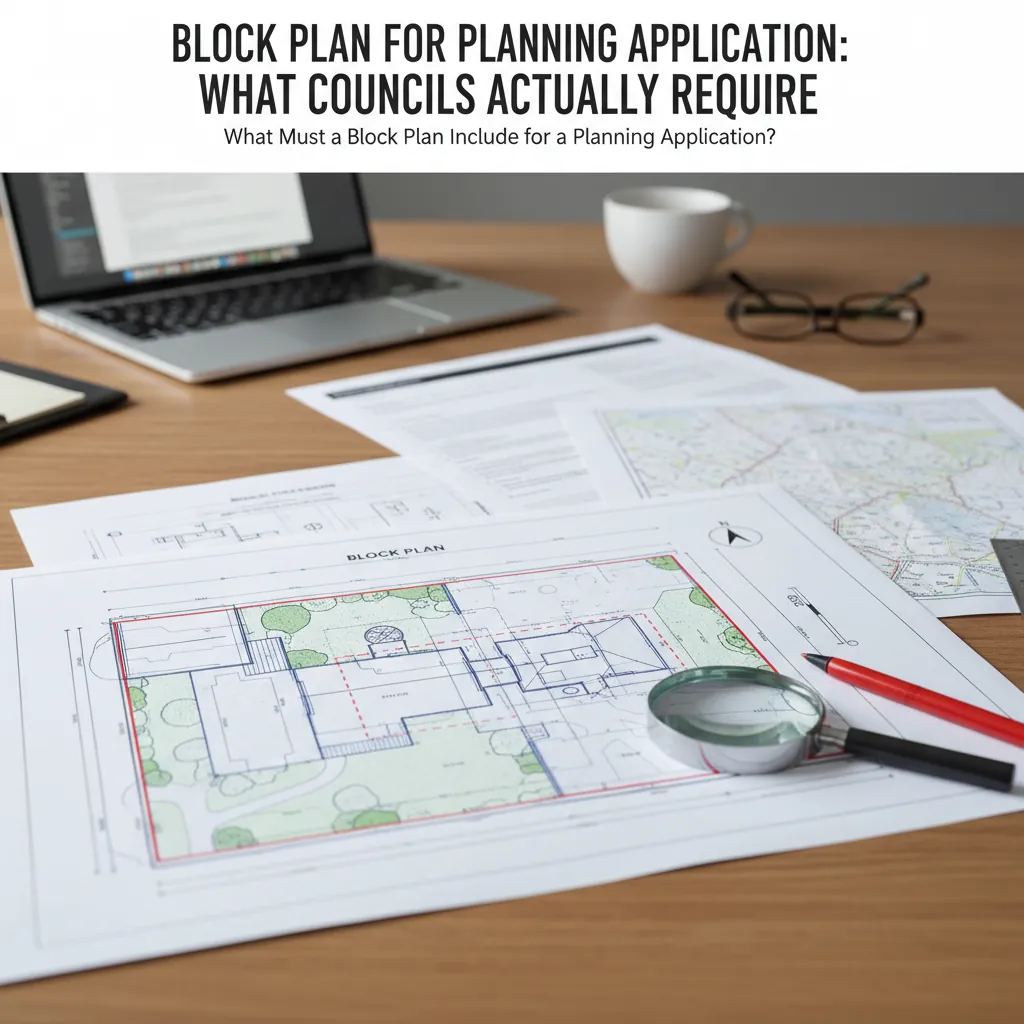
Why Your Block Plan Matters.
How to Prepare a Block Plan on PlanningMapsUK
Getting an official OS block plan is straightforward:
- Enter Your Property Address: Enter your postcode into the search bar.
- Review the OS MasterMap Base: The map automatically centers on your property with high-resolution vector lines.
- Trace Your Red-Line Boundary: Use the intuitive drawing tool to snap along boundary features and connect out to the road.
- Select 1:500 Scale: Choose 1:500 (or 1:200 for dense sites) and select your preferred page size (A4 is typical).
- Download Your Document: Choose PDF for immediate submission or CAD (DWG/DXF) if passing the file to a designer or builder.
Every plan is generated with current Ordnance Survey licensing, Crown copyright metadata, north arrow, and metric scale bar.
Do You Need a Block Plan for Permitted Development?
Under standard Permitted Development (PD) rights, formal planning permission is not required. However:
- If you apply for a Lawful Development Certificate (LDC) to legally verify your build before work starts or to satisfy mortgage lenders, councils require both a site location plan and a 1:500 block plan.
- The block plan provides the mathematical proof that your project complies with PD criteria — such as not exceeding 50% garden coverage, staying under maximum eaves heights, and observing statutory boundary setbacks.
Frequently Asked Questions
Does a block plan need to show the whole garden?
Yes. The block plan must show the full extent of the domestic curtilage and application boundary, including the house, front and rear gardens, and driveway access.
Can I use the same block plan for multiple planning applications?
Only if the application boundary, building footprints, and site conditions remain identical. If the proposal alterations change or your boundary shifts, submit a fresh plan.
What is the difference between a block plan and a proposed site plan?
In almost all UK council validation workflows, block plan and proposed site plan refer to the same document — a 1:500 or 1:200 drawing illustrating the proposed development on the plot.
Does a block plan have to be based on Ordnance Survey mapping?
Yes. Local planning authorities require block plans to be anchored to licensed Ordnance Survey MasterMap data to ensure metric scaling accuracy and legal copyright compliance.
How detailed does a block plan need to be?
It does not need to show internal floor plans or engineering sections. It must clearly present external building footprints, accurate setback dimensions to boundaries, neighbouring structures, and mature trees.
Final Pre-Submission Checks
Before uploading your block plan to the Planning Portal or council portal:
- Double-check that your red boundary matches your 1:1250 location plan exactly.
- Confirm your proposed extension or outbuilding footprint is visibly hatched or annotated.
- Ensure the document includes a metric scale bar and north arrow.
- Verify that neighbouring building footprints bordering your plot are visible.
Order your official 1:500 block plan today on PlanningMapsUK for immediate PDF or CAD download.