
Terminology across UK planning departments can often feel confusing. Different planning authorities, architects, and planning application forms use terms like site layout plan, block plan, proposed site plan, and site drawing — sometimes interchangeably, and sometimes to mean completely different drawings.
This guide clarifies what a site layout plan is, how it compares to your statutory site location plan and block plan, and what information councils expect to see on it.
Need a base map for your layout drawing? Create a detailed site plan on licensed Ordnance Survey mapping, then add the proposal information your application requires. You can also start directly with the block-plan builder. Choose a site location plan when you need the wider context instead. The base map does not include architectural drawings of your proposed works.
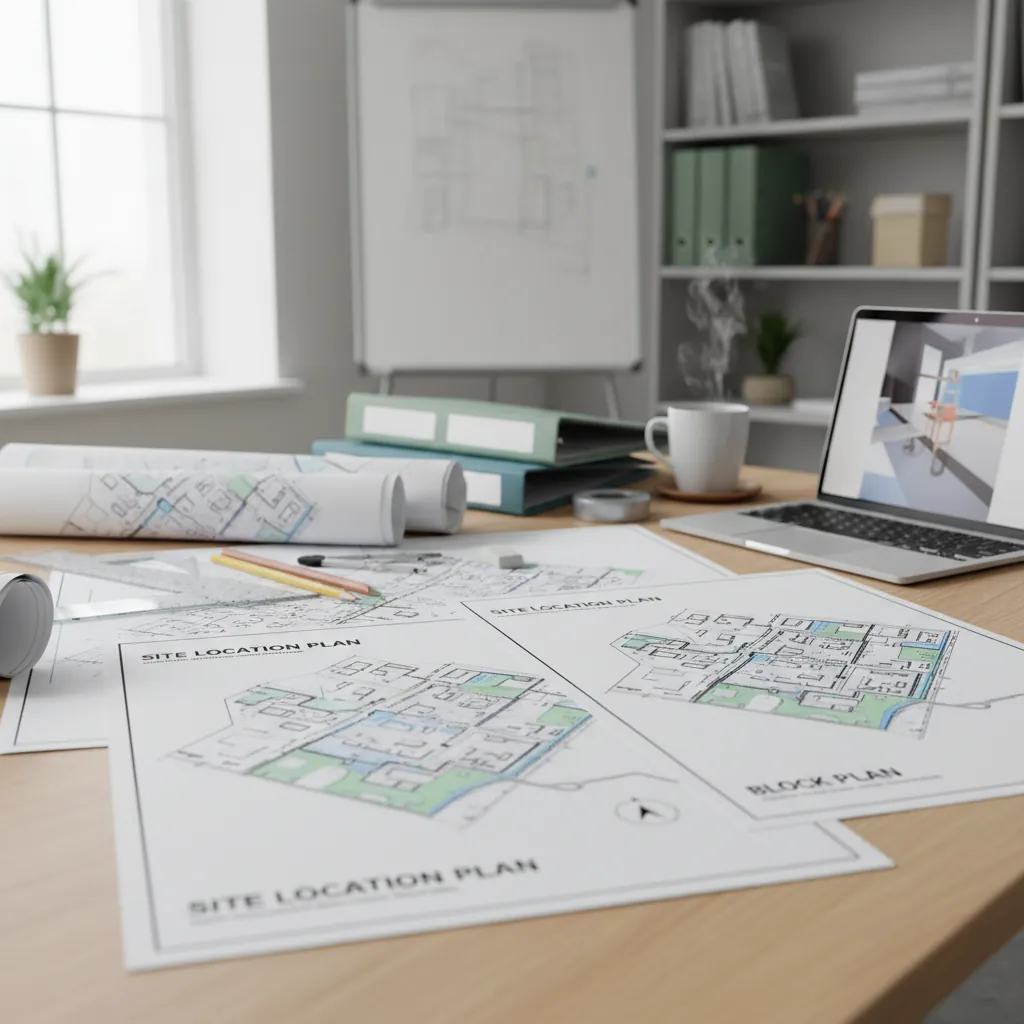
Learn what a site layout plan is, how it differs from a site location plan and block plan, what it must show, and when councils require it for planning applications.
What Is a Site Layout Plan?
A site layout plan is a scaled overhead drawing illustrating the physical arrangement of buildings, access tracks, hardstanding, parking bays, and open spaces across a defined parcel of land.
The term is used across two main project categories:
1. Householder Applications (Domestic Extensions & Outbuildings)
For homeowners extending a house, building a garage, or creating a garden room, the term site layout plan is used synonymously with a block plan or proposed site plan. It is typically prepared at 1:500 scale (or 1:200 for tight urban plots) showing the proposed footprint relative to garden fences, trees, and neighbours.
2. Commercial and Residential Developments (Multi-Unit Schemes)
On larger schemes — such as a small cul-de-sac of five houses, a commercial retail unit, or an industrial yard — a site layout plan is a comprehensive design master drawing. It demonstrates how traffic circulates, where bin stores sit, how sustainable drainage systems (SuDS) are accommodated, and where landscaping buffers will be planted.
Site Layout Plan vs Site Location Plan
While their names sound similar, their statutory roles are entirely distinct:
| Feature | Site Location Plan | Site Layout Plan (Block Plan) |
|---|---|---|
| Standard Scale | 1:1250 (urban) or 1:2500 (rural) | 1:500 (standard) or 1:200 (detailed) |
| Perspective | Wide neighbourhood overview | Close-up plot view |
| Primary Purpose | Answers: "Where is the site located?" | Answers: "How will the site function and look?" |
| Key Features | Roads, street names, highway access point | Building footprints, parking bays, trees, boundaries |
| Mandatory Status | Required for all planning submissions | Required for all physical building developments |
A helpful distinction: The site location plan identifies the site for council GIS records; the site layout plan defines the design on the ground.
What a Site Layout Plan Must Show
Requirements vary depending on project scale:
Householder Developments (1:500 Scale)
- Existing dwelling footprint and any outbuildings to be retained or demolished.
- Proposed extension or outbuilding footprint, highlighted with hatching or colour shading.
- Clear metric dimensions from proposed external walls to site boundaries.
- Boundary treatments (fences, brick walls, hedges) with indicated heights.
- Significant mature trees on or adjacent to the site, showing canopy spreads.
- Driveways, turning spaces, and dropped kerb access to the highway.
- Adjoining neighbouring building footprints.
- True North arrow, metric graphic scale bar, and licensed Ordnance Survey copyright block.
Multi-Dwelling or Commercial Schemes (1:500 or 1:1000 Scale)
- Numbered residential plots with designated private garden areas.
- Adoptable estate roads, footways, and shared-surface driveways.
- Vehicle parking allocations (allocated bays, visitor spaces, EV charging points).
- Swept path tracking showing refuse vehicle and emergency service turning heads.
- Communal bin storage and secure bicycle parking facilities.
- Surface water drainage basins, swales, and soakaway zones.
- Soft landscaping belts, acoustic fencing, and boundary retaining walls.
Technical Layout Disciplines: What Highway and Technical Officers Audit
For residential developments comprising two or more units, planning authorities subject the site layout plan to rigorous multi-disciplinary technical assessments:
1. Swept Path Vehicle Tracking (Autotrack Analysis)
Highway engineers will not approve a residential or commercial site layout unless the drawing proves vehicles can enter, manoeuvre, and leave in a forward gear:
- Refuse Collection Vehicles (RCV): Highway authorities mandate tracking using a standard 11.2-metre, 3-axle municipal refuse collection vehicle. If the site layout features a dead-end cul-de-sac longer than 20 metres, the layout must incorporate a compliant turning head (such as a 16.8-metre diameter turning circle or a standard British hammerhead).
- Fire Appliance Access (Building Regulations Part B5): Under statutory fire safety standards, a 7.9-metre fire tender must be able to approach within 45 metres of all points inside every dwelling, or within 18 metres of an external dry riser inlet. The site layout plan must demonstrate road widths (minimum 3.7 metres carriageway width) and structural bridge capacities capable of supporting a 12.5-tonne fire engine.
- Bin Carry and Pull Distances (Manual for Streets): Residents must not be required to carry domestic refuse sacks more than 30 metres from their front door to the bin store, and waste collection crews must not be expected to pull heavy 4-wheeled Eurobins more than 15 metres from the bin store to the back of the refuse lorry.
2. Accessible Parking Geometry and Building Regs Part M
Parking bays cannot be arbitrarily drawn boxes. Council planning policies enforce strict geometric minimums on site layout plans:
- Standard Domestic Bay: 2.4 metres wide by 4.8 metres long.
- Walled Bays: When a parking space is bounded by a boundary wall, fence, or building flank on one side, its width must increase to 2.7 metres; if bounded by walls on both sides, it must increase to 3.0 metres to allow passenger car doors to open.
- Accessible (Disabled) Bays: 3.6 metres wide (incorporating a 1.2-metre designated painted transfer zone) in accordance with Building Regulations Part M4(2) and M4(3) standards.
- Pedestrian Access Routes: The site layout plan must demonstrate a continuous, level or gently ramped (maximum 1:20 gradient) pedestrian pathway connecting car parking bays directly to principal dwelling entrances.
3. Secured by Design (SBD): Crime Prevention Principles
Police Architectural Liaison Officers (ALOs) routinely review site layout plans under the National Planning Policy Framework (NPPF) to ensure safe, crime-resilient neighbourhoods:
- Natural Surveillance: The layout must ensure that car parking areas and communal footpaths are directly overlooked by active front-facing windows (such as kitchens and living rooms) rather than blank flank walls.
- Defensible Space: The plan should indicate low boundary treatments (0.6m to 0.9m railings or hedges) in front of ground-floor windows to define private domestic space from public footways.
- Eliminating Vulnerable Rear Alleys: Rear access paths serving multiple terraced gardens must be secured by lockable gates positioned as close as possible to the building line to prevent hidden burglary access routes.
Sustainable Drainage Systems (SuDS) on the Site Layout
Under statutory national planning guidance, almost all new residential developments must incorporate Sustainable Drainage Systems (SuDS) to prevent surface water flooding:
- Attenuating Greenfield Run-off Rates: The site layout plan must illustrate where stormwater will be captured and temporarily stored during a 1-in-100-year storm event (plus a 40% climate change allowance).
- Surface Features vs Sub-surface Crates: Planning committees strongly favor above-ground green infrastructure over buried plastic attenuation crates. The site layout should integrate bio-retention swales, rain gardens, permeable tarmac/paving, and attenuation retention basins into communal amenity spaces.
- Discharge Points: The layout must identify the final destination of surface water, strictly following the SuDS discharge hierarchy: (1) infiltration into ground soakaways, (2) discharge to a natural watercourse, (3) discharge to a surface water sewer, and only as an absolute last resort, (4) discharge to a combined public sewer.
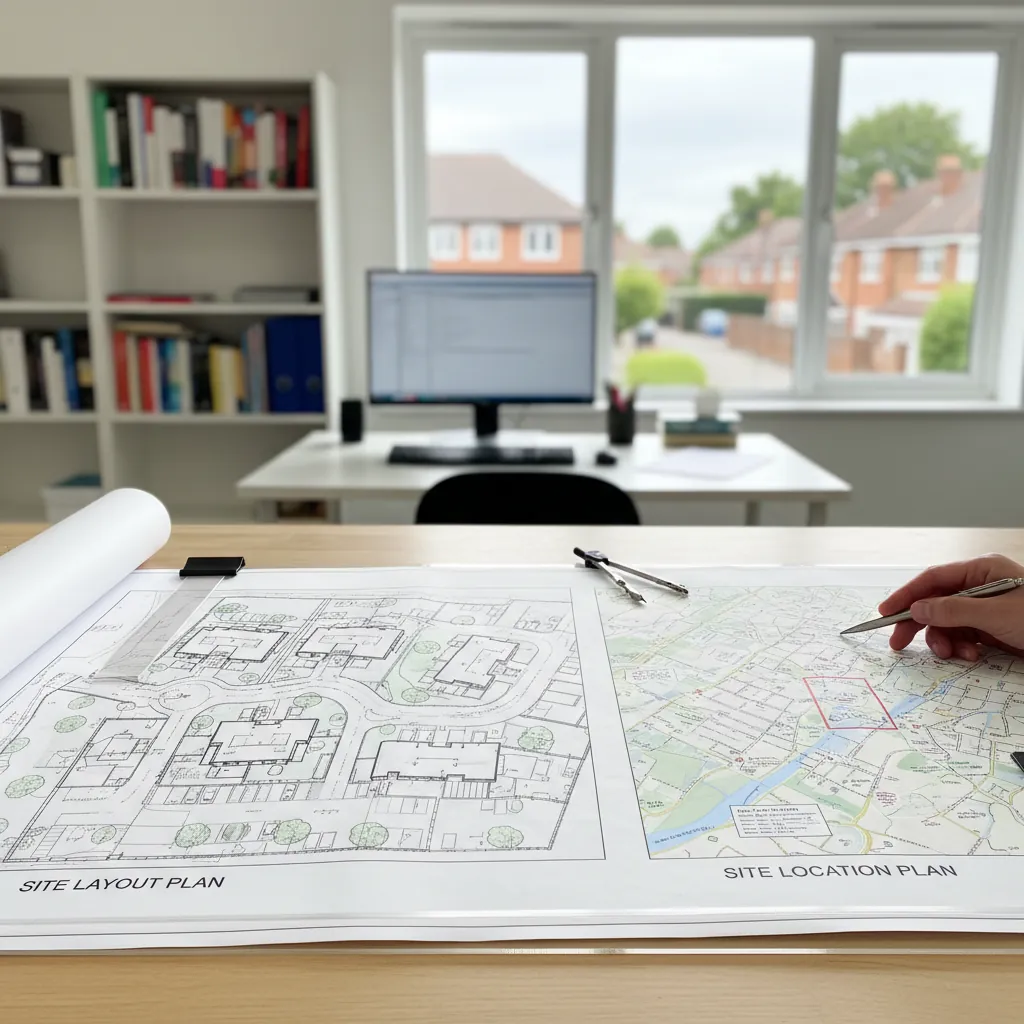
What Is a Site Layout Plan?.
Choosing the Right Scale
Selecting the appropriate drawing scale depends on physical site dimensions:
- 1:200 Scale: Best for very compact urban plots, mews properties, or intricate single-building renovations where precise millimeter setbacks are critical.
- 1:500 Scale: The national standard for single-house developments, extensions, and small plots up to roughly half an acre.
- 1:1000 Scale: Common on multi-unit developments (5–30 homes) where the entire road network must fit onto an A1 or A2 sheet.
- 1:2500 Scale: Used primarily for strategic rural master plans or long infrastructure corridors, supported by closer 1:500 detailed phase plans.
Every site layout drawing must feature a matching graphic metric scale bar so planners can verify dimensions regardless of screen scaling.
How to Prepare Your Site Layout Plan
To ensure your plan passes validation without delays:
- Start with Licensed OS MasterMap Vector Data: Never build your site layout on top of satellite screenshots or uncalibrated raster images. An official OS MasterMap base guarantees that plot boundaries, road widths, and neighbouring properties reflect true national grid coordinates.
- Obtain CAD Files (DWG/DXF) for Your Architect: If an architect, planning consultant, or civil engineer is designing your site layout, supply them with an editable CAD planning map. They can snap proposals directly to existing wall lines without manual tracing.
- Check Portal PDF Requirements: When exporting the finished drawing for the Planning Portal, ensure it is saved as a vector PDF at 100% actual scale, with all layer fonts embedded and file sizes under portal upload thresholds.
Frequently Asked Questions
Is a site layout plan the same as a block plan?
For typical householder applications (extensions, garden buildings), yes. Both terms refer to the detailed 1:500 map showing the proposed works on the plot. For larger multi-unit developments, a site layout plan refers to a broader architectural drawing showing road networks, plots, parking, and landscaping.
Is a site layout plan the same as a floor plan?
No. A site layout plan is an overhead map showing building footprints, gardens, and vehicle routes across the plot. A floor plan is an internal architectural drawing illustrating room layouts, wall positions, and door swings.
Does a site layout plan need to be drawn by an architect?
The underlying topographic base map must be obtained from licensed Ordnance Survey MasterMap data. For simple domestic extensions, you can annotate this base map yourself. For complex residential or commercial developments, an architect or draughtsperson typically prepares the detailed overlay.
What scale should a site layout plan be?
1:500 is standard for residential plots. 1:200 is used on tight urban plots, while 1:1000 or 1:2500 is used for larger multi-acre developments and estate master plans.
What are swept path analyses on a site layout plan?
On commercial schemes and multi-dwelling developments, councils often require a swept path analysis overlay showing that refuse lorries, fire tenders, and delivery vans can enter, turn, and exit the site in forward gear.
Next Steps
Whether you are submitting a simple house extension or commissioning a multi-dwelling layout:
- Obtain a licensed 1:1250 Site Location Plan for statutory neighbourhood identification.
- Prepare an accurate 1:500 Block Plan or Site Layout Plan demonstrating the proposed development footprint.
- Ensure all drawings feature calibrated scale bars, north arrows, and OS Crown copyright licensing.
Generate your licensed 1:500 block plan or CAD planning maps on PlanningMapsUK in minutes.