
When submitting a planning application in the UK, few elements are as legally significant as the red line boundary.
The red line is not merely a visual highlight around a house; it establishes the formal legal definition of the application site. Planning permission attaches to the land, not the individual applicant. The land enclosed within that continuous red perimeter is the only land upon which development can lawfully take place and to which planning conditions can be applied.
Getting the boundary wrong is one of the most common causes of planning validation failure.
Here is a practical guide to the red line boundary rule: what must be included, how the access requirement works, when to use a blue line, and how to avoid costly resubmissions.
If you need to prepare your map now, generate an official site location plan or block plan using our interactive boundary tools.

Everything you need to know about the Red Line Boundary in planning applications.
What Does the Red Line Boundary Mean?
In UK planning law, the red line identifies the planning unit and all land directly involved in the development proposal:
- Inside the line: Land forming part of the planning application.
- Outside the line: Land excluded from the application, where no development is permitted and no planning conditions can be imposed.
This boundary must appear identically on both your 1:1250 site location plan and your 1:500 block plan. If the red line on your location plan covers the driveway but your block plan cuts off at the lawn, the validation team will flag the application as inconsistent.
What Must Be Enclosed Within the Red Line?
A frequent mistake made by householders is drawing the red line tightly around the proposed extension footprint (for instance, just the new kitchen extension). This is incorrect.
The red line must encompass all land required to carry out the development:
For Standard Domestic Extensions
For a typical house extension, loft conversion, or garage alteration, the red line should enclose the entire domestic curtilage:
- The dwelling itself
- Front, rear, and side gardens
- Patios, paths, and outbuildings within the curtilage
- Driveways, parking areas, and turning heads
- The access route all the way to the adopted public highway
Enclosing the entire domestic plot allows the case officer to evaluate overall site coverage, remaining amenity space, parking standards, and boundary separation distances.
For Large Rural Sites and Farms
On agricultural holdings, equestrian units, or large rural properties, you do not need to enclose a 50-acre holding in red. The red line should outline only the building being converted or erected, its immediate operational yard/curtilage, and the access track connecting it to the public road. Any adjoining farmland you own is then edged in blue.
The Highway Access Rule (The Most Common Pitfall)
Under national Planning Practice Guidance, the application site boundary must connect continuously to the public adopted highway.
If you live down a private lane, shared driveway, or access track:
- Your red line must follow that private track all the way out to where it meets the council-maintained public road.
- If your boundary stops at your private gate or the edge of your lawn, leaving a gap before the adopted road, the application will be rejected at validation.
What if You Do Not Own the Access Track?
Applicants often ask: "Can I put someone else's land inside my red line?"
Yes. You do not need to own land to include it within a planning application red line. If you hold a right of way over a shared private lane, you include the access route within your red line and complete Certificate B on the ownership certificate section of your application form. You must serve formal notice on the owner of the track to notify them that a planning application has been submitted.
The "Blue Line" Rule: Identifying Wider Ownership
If you own or control land immediately adjacent to the application site that is not part of the proposed development, you must outline it with a continuous blue line:
- Red Line: The application plot and access route.
- Blue Line: Adjoining fields, paddocks, or adjacent properties under the same ownership.
The blue line provides planning officers with the full picture of your landholding. This is particularly relevant when:
- Assessing potential expansion or cumulative impact.
- Agreeing planning conditions or Section 106 obligations (for example, off-site landscaping, tree planting, or ecological mitigation on adjacent land).
If you do not own any adjoining land, no blue line is required.
Negative Planning Conditions and the Grampian Rule
Understanding the boundary between the red line and the blue line leads directly into one of the most famous legal doctrines in British planning law: The Grampian Condition.
Established in the House of Lords case Grampian Regional Council v Aberdeen District Council 1983:
- Positive Conditions vs Negative Conditions: An LPA cannot legally impose a condition requiring you to carry out physical works on land outside your red line (such as widening a road junction or planting visibility hedges on land you do not own).
- The Grampian Mechanism: The council can impose a negative condition preventing you from commencing development until specific works are completed on external land (e.g. "No development shall commence until the junction visibility splay shown shaded green on Drawing PL-02 has been cleared of all obstructions over 0.6m in height").
- Blue Line Land as Mitigation: If you own adjoining agricultural land edged in blue, case officers can safely attach planning conditions requiring biodiversity habitat enhancement, surface water drainage attenuation basins, or tree planting within that blue line to offset the development within your red line.
Ransom Strips and the Highway Boundary Edge
One of the most dangerous hidden traps for property owners involves ransom strips:
- What Is a Ransom Strip? A ransom strip is a narrow slither of land—often just a few inches wide—retained by a previous developer or third party along the boundary between a private driveway and the adopted public highway.
- The Invalidation Risk: If your red line stops at your property fence, leaving an unadopted verge or ransom strip between your gate and the tarmac, the council cannot verify legal vehicular access.
- The Ownership Trap: If you draw your red line across a known third-party ransom strip without serving formal Notice No. 1 under Certificate B, the affected third party can challenge your application during public consultation, creating severe legal gridlock.
To avoid this, inspect highway adoption records (using your county council's definitive highway map) to verify exactly where the public highway boundary ends and private land begins.
Modifying the Boundary: Can You Shrink a Red Line? (The Wheatcroft Rule)
While national planning guidance strictly prohibits expanding a red line mid-application (because expanding the site would disenfranchise neighbours who were not consulted on the larger area), can you shrink a red line?
Under the landmark court ruling Bernard Wheatcroft Ltd v Secretary of State for the Environment 1982:
- An applicant is permitted to reduce or contract the red-line site area during an application or appeal, provided the change does not alter the fundamental character or description of the development proposal.
- For example, if a developer applies for five houses on 1.0 hectare, the case officer and applicant can agree to shrink the red line to exclude an ecologically sensitive woodland parcel and reduce the scheme to three houses without triggering a brand new application.
- However, if reducing the red line would deprive affected neighbours of their right to comment on re-sited buildings, the officer will decline the amendment and request a fresh submission.
Community Infrastructure Levy (CIL) and Red Line Area Calculations
The exact area enclosed by your red line carries direct financial implications under the Community Infrastructure Levy (CIL) Regulations 2010:
- Site Area and Thresholds: Local authorities charge CIL based on net additional gross internal floor area (GIA) created within the planning application boundary.
- Subdividing Plots: Drawing an excessively large red line around an entire multi-acre garden when applying for a single dwelling can artificially inflate open space maintenance calculations or trigger major development thresholds (e.g., sites exceeding 0.5 hectares or 10 dwellings), exposing applicants to heavy statutory affordable housing contributions under Section 106 agreements.
- Precision Matters: Keeping your red line tightly anchored to the genuine operational curtilage protects you against inflated local authority infrastructure levies.
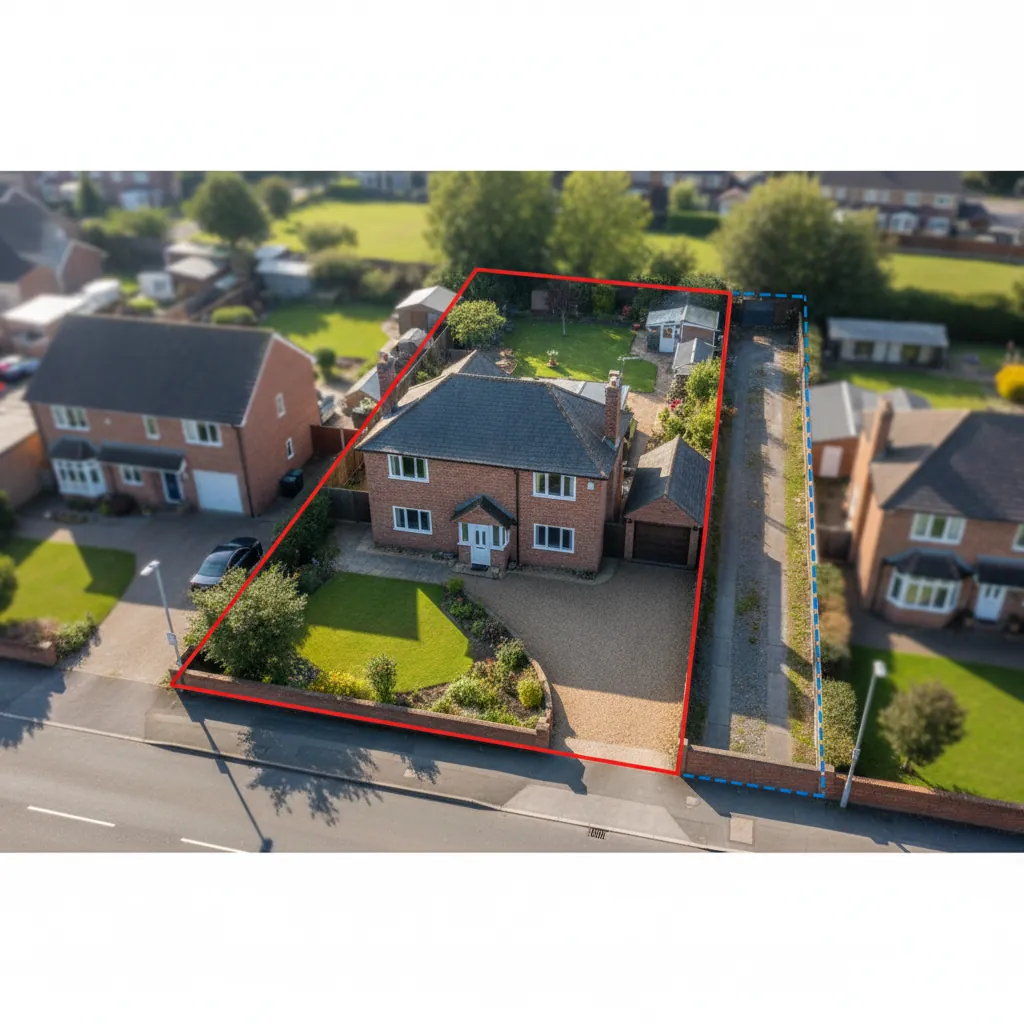
What is the Red Line Boundary?.
Flats and Leasehold Properties
Applying for planning permission on a leasehold flat or maisonette introduces specific boundary nuances:
- 1:1250 Location Plan: The red line should outline the entire building footprint and its communal curtilage/grounds, extending to the highway.
- Certificate of Ownership: Because you typically own the leasehold of your flat rather than the freehold of the entire structure, you must complete Certificate B and serve notice on the freeholder and management company.
- Detailed Drawings: Individual floor plans and elevation drawings specify the precise internal demise and external alterations of your flat.
Can You Amend the Red Line After Validation?
Once an application has passed validation and been registered for statutory public consultation, the red line boundary cannot be expanded.
If you discover halfway through the process that you omitted a private access track or excluded a parcel of land needed for parking:
- The case officer cannot simply redraw the line, because statutory neighbours were consulted on the original boundary.
- You will normally have to withdraw the application and resubmit with corrected plans.
- This resets the statutory 8-week determination period from day one.
Getting the red line right before submitting saves weeks of avoidable delay.
Four Common Red Line Errors
- Drawing Too Tightly: Only outlining the proposed extension footprint instead of the whole domestic curtilage.
- Leaving the Highway Gap: Stopping the red line at the property gate, omitting the connection to the adopted highway.
- Inconsistent Line Weights and Paths: Submitting a location plan and block plan where the boundaries follow different fence lines.
- Incorrect Colour Choice: Using orange, green, or pink instead of a solid, clear red line.
Frequently Asked Questions
What does the red line boundary mean in planning?
The red line boundary defines the exact application site. It identifies all land necessary to carry out the proposed development, including access to the public highway.
Does the red line have to follow the physical fence line?
It should follow the legal extent of the planning unit under your ownership or control. While this often matches physical fences, any legal discrepancy or inclusion of access land must be reflected.
Why must the access route to the road be in the red line?
Planning permission runs with the land. If the access to the public highway is excluded, the council cannot verify legal and safe access for emergency services, construction vehicles, or daily use.
What is the purpose of the blue line on a planning map?
The blue line outlines any other adjoining land owned or controlled by the applicant that is not part of the current application, helping the council understand wider landholding context.
Can I amend the red line boundary after validation?
No. Once validated, altering the red line usually requires withdrawing the application and resubmitting with corrected plans, because statutory consultation boundaries cannot be expanded mid-process.
Summary Checklist Before Submission
- Red line outlines the full domestic curtilage or operational area.
- Red line extends continuously to the adopted public highway.
- Certificate B completed if any part of the red line crosses third-party land.
- Any adjoining land in the same ownership is outlined in blue.
- Boundaries match exactly between 1:1250 location plan and 1:500 block plan.
Generate your compliant site location plan on PlanningMapsUK with automated boundary drawing tools that snap directly to OS MasterMap parcel lines.