
If you are standing at the back door asking which fence is mine, the tempting answer is “the one on the left” or “the one with the posts facing you”. Neither is a dependable rule.
In England and Wales, there is no general law that automatically gives every homeowner the left fence, the right fence or the “good” side. The useful answer comes from the documents for the two properties, any agreements between owners, and what can be established on the ground.
This guide explains what to check, what T-marks can mean, and what to do before you repair, replace or remove a boundary fence.
New: Boundary Finder
Find your property's registered general boundary
Search an address, preview the matching HM Land Registry boundary, then order a PDF report with OS and satellite maps, coordinates, distances and a practical fencing guide.
- Land Registry INSPIRE data
- GPS points and bearings
- PDF report by email
Shows a general boundary for practical checks, not the exact legal boundary.
From £35 per report
Free previewSearch your address
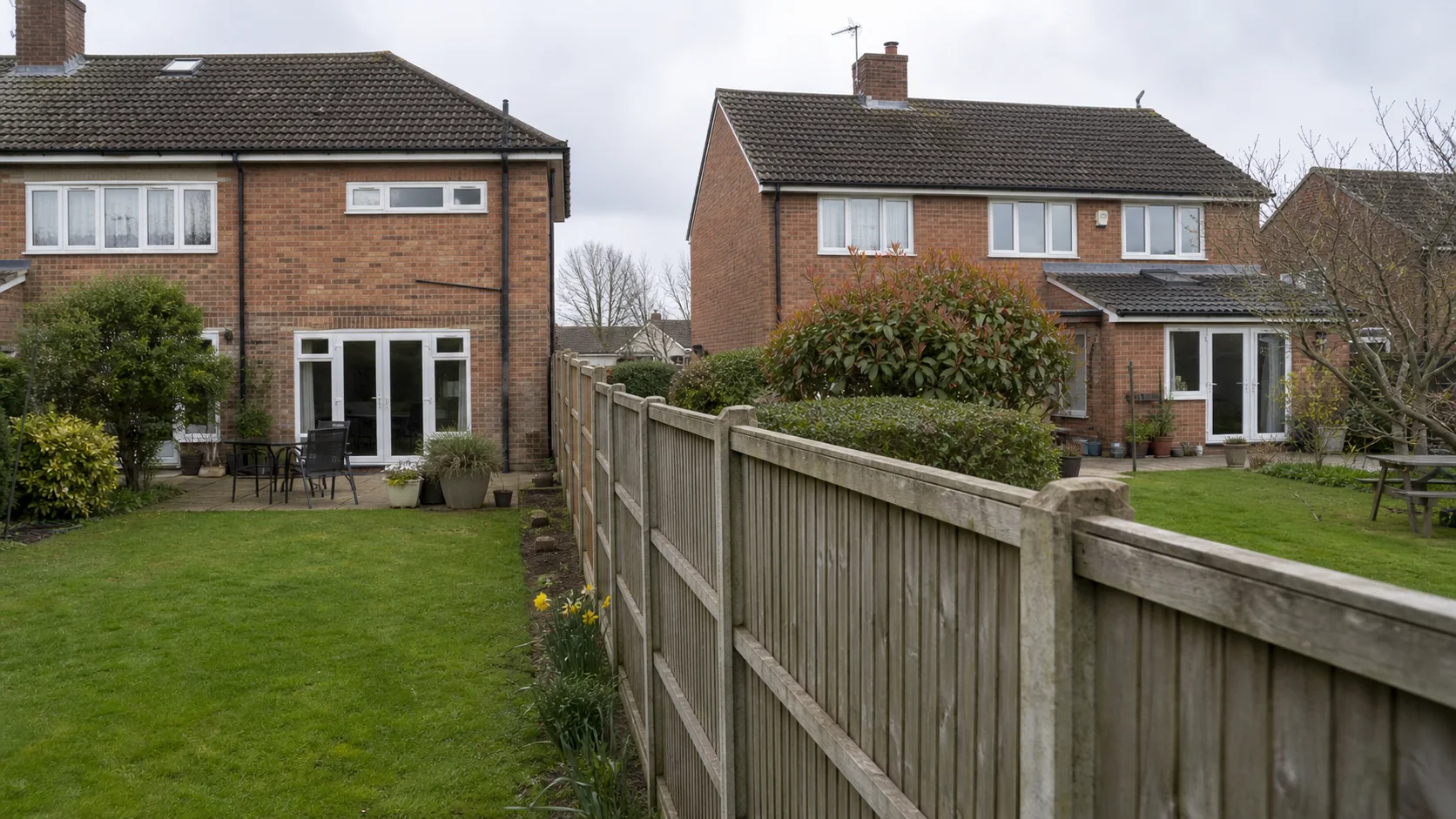
A fence can mark the practical division between two gardens without revealing who owns it or where the exact legal boundary lies.
The short answer: which side of the fence is mine?
There is no universal left-or-right rule. Facing the garden from the house does not make the left fence yours. Facing the house from the road does not reverse a hidden rule. Similar homes on the same estate may have repeated obligations in their original transfers, but that is a matter of evidence, not a national convention.
The official HM Land Registry property-boundaries guidance says there is usually no record of who owns the hedge, wall, tree or fence between two properties. That can feel unsatisfactory, but it prevents a weak clue from being treated as proof.
For a sensible first check:
- Read your title register as well as the title plan.
- Obtain any filed transfer, conveyance or deed referred to in the register.
- Check the neighbour's title documents where possible.
- Look for express maintenance wording, T-marks or a boundary agreement.
- Compare the documents with the site, but do not treat fence construction as decisive.
- Speak to the neighbour before arranging work.
Fence ownership, maintenance and the legal boundary are different questions
People often use “who owns the fence?” to mean three different things:
| Question | What it is really asking | Evidence that may help |
|---|---|---|
| Who owns the fence panels and posts? | Ownership of the physical structure | Deeds, purchase history, receipts, agreement and site evidence |
| Who must repair or replace it? | Maintenance responsibility | Covenants, transfer wording, T-marks and later agreements |
| Where is the boundary between the properties? | Position of the legal line | Deeds, plans, physical and historical evidence, expert interpretation |
The answers do not have to be the same. A covenant can require one owner to maintain a fence without transferring ownership of the land beneath it. A fence can also sit wholly on one owner's land, directly over the boundary or slightly away from it.
HM Land Registry's current practice guide on boundaries distinguishes the invisible legal boundary from a physical fence, wall or hedge. The physical feature may follow the legal line, but it may also sit to one side of it.
That distinction matters before you attach trellis, paint a neighbour's structure, remove posts or assume that paying for a replacement changes the ownership position.
How to find out who owns a fence
There is rarely one perfect document. Work through the evidence in an order that avoids unnecessary cost and conflict.
1. Check the title register
The register is the written record associated with the registered title. Read the property, proprietorship and charges sections rather than searching only for the word “fence”. Relevant wording may refer to boundaries, walls, hedges, maintenance, repair, covenants or a transfer made on a particular date.
A register entry may say that a deed contains provisions affecting boundaries. If so, the register is pointing you towards another document; it is not giving the whole answer itself.
2. Read the title plan with the register
The title plan shows the general extent of registered land, usually edged in red. It does not normally show the exact legal line, and the thickness of the red edging must not be used as a measuring tool.
A red line running beside a fence symbol does not prove that the fence belongs to the red-edged title. It shows the title in its map context at the plan's scale. Our Land Registry boundary map guide explains how to read that relationship without claiming more precision than the plan contains.
3. Order any filed deeds or transfer documents
Older conveyances and modern transfers can contain the useful detail missing from the title plan. Look for:
- A plan with lettered or coloured boundaries
- A covenant to maintain a named side
- T-marks or inward-facing T symbols
- Measurements tied to permanent features
- A description such as “the western boundary”
- Rights to use, repair or enter land beside the boundary
Do not assume every deed mentioned in the register is automatically available or that every old marking remains legally decisive. The point is to assemble the documentary history, not to hunt for one symbol that supports a preferred answer.
4. Check the neighbouring title
Your documents may be silent while the adjoining title contains a useful transfer or covenant. Comparing both sides can also expose inconsistencies. For example, both registers might repeat an old estate covenant, or neither may allocate responsibility at all.
HM Land Registry's guidance on finding information it holds recommends obtaining the title register, title plan and filed deeds when checking registered boundary details. It also notes that specific boundary-ownership information is rarely held.
5. Look for later agreements and practical history
Ask whether previous owners signed a boundary agreement, shared the cost of a fence or recorded an arrangement during earlier building work. Keep invoices, dated photographs and correspondence. These may help explain what happened, although they do not automatically rewrite the legal boundary.
What do T-marks on title plans mean?
A T-mark is a short line meeting a boundary line in the shape of a T. It is often drawn on the side associated with the property expected to maintain or own the boundary feature.
The crucial phrase is often, not always.
Under HM Land Registry's practice guidance, a T-mark is useful where the deed and register expressly refer to it. If a T-mark appears on a deed plan but the written deed gives it no meaning, it may have no special legal force. The wording attached to the mark matters more than internet diagrams that label one side “yours”.
An H-shaped arrangement, sometimes described as two mirrored T-marks, may indicate a shared obligation where the supporting text says so. Again, read the words.
No T-marks on the title plan
Many title plans have no T-marks at all. This does not mean:
- Both fences automatically belong to you
- Each owner takes the left fence
- Responsibility follows the position of the posts
- Nobody can repair the feature
- The boundary itself is missing
It means that the title plan is not providing that shortcut. Continue with the register, filed documents, neighbouring title and any agreement between owners.
Do the posts or “good side” prove fence ownership?
No. A widely repeated claim says the owner keeps the posts and rails on their side, leaving the finished face towards the neighbour. That may reflect a builder's habit or the preference of the person who installed it, but it is not a legal ownership test.
Fences are replaced. Panels are turned. Concrete posts may be reused by a different owner. A contractor may choose the easiest direction to work from. Historic photographs can show when the structure changed, but its construction cannot safely overrule the documents.
HM Land Registry's boundary practice guide is direct on this point: beliefs about ownership based on the way a wall or fence is constructed have no legal foundation.
Can a Land Registry boundary map tell you which fence is yours?
Usually not. The registered title plan shows a general boundary, not ownership of every physical feature along it. Ordnance Survey mapping may depict a fence, wall or hedge because it is a topographic feature. That does not turn it into a legal ownership line.
PlanningMapsUK Boundary Finder can still be a useful early research tool. Search the address, preview the matching HM Land Registry INSPIRE polygon and compare its general shape with Ordnance Survey and satellite context. The £24.99 report includes numbered points, coordinates, distances, bearings and a practical 15-page fence and boundary guide.
Use it to understand the registered extent and organise a site conversation. Do not use it to tell a neighbour “this proves the fence is mine”. It does not replace the official title register and title plan, a boundary survey, a determined boundary or legal advice.
Before repairing or replacing a boundary fence
A rotten panel does not always need a legal investigation. A whole-line replacement, a change in height or a disputed strip of land deserves more care.
Use this checklist before work starts:
- Identify the feature. Confirm which run of fence is affected and whether it changes direction or meets another boundary.
- Read the documents. Check both the register and any available deeds, not only a downloaded plan image.
- Record the current position. Take dated photographs from fixed viewpoints. Note posts, walls, corners and changes in ground level.
- Discuss access. A contractor may need permission to enter the neighbouring garden even if you are responsible for the fence.
- Agree the line and specification. Record the intended position, height, material, cost split and ownership of the new structure.
- Avoid moving the line casually. Rebuilding a fence in a more convenient position can create later uncertainty over the land between the old and new lines.
- Check other rules. Planning limits, restrictive covenants, listed-building controls and highway visibility can affect a fence independently of ownership.
For a straightforward shared replacement, a short written agreement and annotated photographs may prevent a future misunderstanding. Where land ownership is in question, get advice before reducing the issue to a contractor's sketch.
Common fence situations
“My neighbour says the left fence is always mine”
Ask what document supports that claim. If both owners bought on the same estate, their transfers may contain a repeated pattern, but the side rule must come from those documents rather than folklore.
“The fence is inside my garden, so I own it”
Possibly, but not automatically. A structure can sit away from the legal line. Compare the deed evidence and history before treating the gap as a transferred strip of land.
“I paid for the new fence”
Payment is useful evidence about the physical fence, especially if there is a written agreement. It does not by itself determine the legal boundary or cancel an existing covenant.
“The title plan has a T on my side”
Find the register entry or deed clause that explains it. A mark and its written provision should be interpreted together.
“Neither title says anything”
That is common. Agree a practical arrangement if possible. HM Land Registry's guidance says that where ownership or maintenance cannot be determined, alterations or replacement should be made with the adjoining owners' agreement.
When a fence question becomes a boundary dispute
Pause if the disagreement concerns a strip of land, the position of an extension, access rights or removal of a long-standing feature. Do not move the fence first and ask questions later.
Collect the documents, photographs and correspondence. Write down what is actually disputed: ownership of the panels, repair cost, the legal line or use of land. Those are different problems and may need different solutions.
The RICS consumer guide to boundary disputes explains how a specialist surveyor may consider deeds, plans, site features, historic documents and aerial photographs. Mediation or a boundary agreement can sometimes resolve the issue without court proceedings. If the exact legal line must be recorded, a determined-boundary application has stricter evidence and plan requirements.
Statutory Planning Controls: Permitted Development Fence Heights
Regardless of who owns a fence, erecting or replacing boundary treatments is strictly governed by planning legislation under The Town and Country Planning (General Permitted Development) (England) Order 2015 (GPDO), Schedule 2, Part 2, Class A:
1. The Statutory Height Rules
- Adjacent to a Highway Used by Vehicular Traffic: The maximum height allowed under Permitted Development without planning permission is 1.0 metre (3.28 feet). This applies to front garden fences, side fences running along footpaths adjacent to roads, and boundary walls near junctions where visibility splays must be preserved for road safety.
- Any Other Boundary (Rear & Side Gardens): The maximum height permitted is 2.0 metres (6.56 feet) above natural ground level. This includes any trellis topping. If you install a 1.8m featheredge fence with a 0.6m trellis, the total height reaches 2.4m, making it unlawful without full planning permission.
- Listed Buildings and Conservation Areas: Permitted Development rights to erect fences are withdrawn if your property is a listed building or lies within the curtilage of a listed building. Furthermore, many councils issue Article 4 Directions across modern housing estates or conservation zones, removing Class A rights to preserve open-plan street scenes.
2. Measuring Fence Height on Sloping Ground or Retaining Walls
Where land slopes between two gardens, height is legally measured from the natural ground level on the side where the ground is highest. However, if a fence is built atop a retaining wall, planning authorities calculate height from the lower ground level unless the retaining structure forms an established ground terrace.
Access for Maintenance: The Access to Neighbouring Land Act 1992
If you establish that a dilapidated fence is your legal responsibility, you may need to enter your neighbour’s property to dig post holes, pour concrete, or erect panels:
- Common Law Trespass: You have no automatic common-law right to step onto a neighbour’s soil or lean ladders against their property without their consent, even to maintain your own boundary feature.
- The Access to Neighbouring Land Act 1992: If a neighbour unreasonably refuses access for essential preservation or repair of an existing structure, you can apply to the County Court for an Access Order. The court will grant an order if the work is basic preservation and cannot reasonably be carried out without entry, provided it does not cause undue hardship or damage to the neighbour.
- New Structures Excluded: The 1992 Act applies only to the repair or maintenance of existing structures. You cannot obtain an access order to erect a brand new fence where none existed previously.
Adverse Possession and Shifting Fence Lines (LRA 2002)
Leaving a boundary line unresolved can trigger irreversible legal property transfers under the doctrine of Adverse Possession:
- The 10-Year Boundary Exception: Under Schedule 6, Paragraph 5(4) of the Land Registration Act 2002, a neighbour who occupies a strip of your land following the erection of an incorrectly placed fence can apply to HM Land Registry for freehold title after 10 years of continuous exclusive possession, provided they reasonably believed the land belonged to them.
- Pre-2002 Unregistered Land: For unregistered land, the older 12-year limitation period under the Limitation Act 1980 still operates, automatically extinguishing paper title.
- Preventing Squatter Claims: If you permit a neighbour to temporarily place a fence on your land for convenience, always execute a signed Written Licence or formal Boundary Agreement. Written permission destroys the "adverse" requirement, completely defeating any future adverse possession claim.
A sensible conclusion, not a side rule
The honest answer to “which fence is mine?” is often “check the evidence and agree before acting”. That is more useful than a confident left-or-right myth.
Start with the title register, title plan and filed deeds. Use Boundary Finder to view the registered general boundary in practical map context, then bring in a surveyor or solicitor if the exact line or ownership has real financial consequences.