
One of the most frequent reasons planning applications are rejected during initial validation is incorrect map scaling.
For homeowners and builders who do not deal with architectural drawings every day, terms like 1:1250, 1:500, or 1:200 can feel like unnecessary technical jargon. Does it really matter if a plan is slightly zoomed in or out?
To a council planning department, scale is everything. Planning officers do not simply look at your drawing as a general picture — they measure directly from it. Using digital measurement software or a physical metric scale ruler, the case officer verifies the exact distance from your proposed extension to the neighbouring boundary, checks for daylight infringement, and confirms parking space dimensions. If the map scale is distorted or uncalibrated, those measurements are legally compromised, and the council must invalidate your submission.
Here is a practical guide to UK planning map scales: which scale to use for each document, how paper sizes affect scaling, and how to make sure your plans pass validation without a hitch.
If you already know the scale you need, order your 1:1250 site location plan or 1:500 block plan directly. You can also use our planning map scale chooser to compare coverage.
Quick Reference Scale Guide
| Metric Scale | Document Type | Best Used For |
|---|---|---|
| 1:1250 | Site Location Plan | Identifying the property within the neighbourhood, showing surrounding streets, road names, and highway access. |
| 1:500 | Block Plan / Site Plan | Showing the proposed extension, garden boundaries, outbuildings, driveways, and trees in close detail. |
| 1:200 | Detailed Site Layout | Constrained urban plots, tight boundary interfaces, or complex multi-unit parking layouts. |
| 1:2500 | Rural Location Plan | Large rural acreage, farms, estates, and woodland where 1:1250 cannot capture the nearest adopted road. |
For standard householder applications (such as a rear extension, loft dormer, or outbuilding), you will almost always submit a 1:1250 location plan alongside a 1:500 block plan.
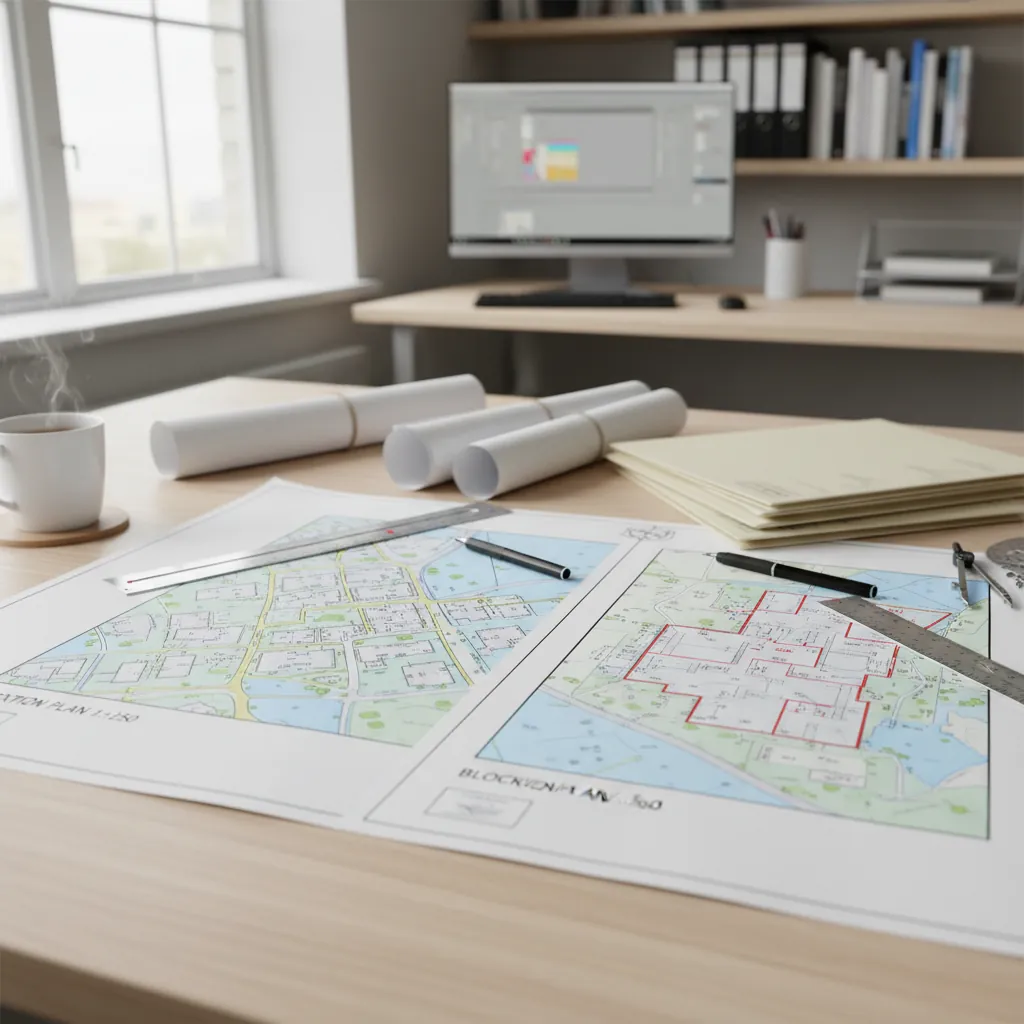
Confused by planning map scales?
How Metric Map Scales Work
Metric scales represent real-world ground distances proportionally:
- 1:1250 Scale: 1mm on paper = 1.25m on the ground (1cm = 12.5m). On a standard A4 sheet, a 1:1250 map captures roughly 350m × 250m of ground context.
- 1:500 Scale: 1mm on paper = 0.5m on the ground (1cm = 5m). On an A4 sheet, a 1:500 map covers roughly 150m × 100m.
- 1:200 Scale: 1mm on paper = 0.2m on the ground (1cm = 2m). An A4 sheet covers roughly 60m × 40m.
The Ratio Principle
- Larger ratio numbers (1:1250, 1:2500) mean you are zoomed out. You see extensive neighbourhood context (streets, railway lines, nearby estates) but less fine detail.
- Smaller ratio numbers (1:500, 1:200) mean you are zoomed in. You see the exact outline of walls, fence boundaries, patios, and tree canopies.
The Mathematics of Metric Planning Scales: Quick Conversion Guide
Understanding the exact mathematical relationship between paper millimetres and ground metres helps verify drawings before submission:
$$\text{Distance on Ground (metres)} = \frac{\text{Distance on Paper (mm)} \times \text{Scale Factor}}{1000}$$
| Scale Ratio | 1 mm on Paper Equals | 1 cm on Paper Equals | 10 cm on Paper Equals | Standard Scale Rule Face (BS 6306) |
|---|---|---|---|---|
| 1:200 | 0.20 metres (200 mm) | 2.0 metres | 20.0 metres | Standard Triangular Rule Face 1 |
| 1:500 | 0.50 metres (500 mm) | 5.0 metres | 50.0 metres | Standard Triangular Rule Face 2 |
| 1:1250 | 1.25 metres (1250 mm) | 12.5 metres | 125.0 metres | Standard Surveyor Rule Face 3 |
| 1:2500 | 2.50 metres (2500 mm) | 25.0 metres | 250.0 metres | Standard Ordnance Survey Rule Face 4 |
Why Councils Reject "Non-Standard" Scales (1:300, 1:750, 1:1000)
Occasionally, an applicant or inexperienced draftsman will adjust the zoom slider in drawing software so that a plot fits neatly on an A4 sheet, producing a non-standard ratio such as 1:350 or 1:750.
- British Standard Scale Rulers (BS 6306): In the UK, physical and digital scale rules manufactured to British Standards only feature established metric gradations: 1:1, 1:20, 1:50, 1:100, 1:200, 1:500, 1:1250, and 1:2500.
- Immediate Invalidation: If a council validation officer receives a plan drawn at 1:750 or 1:400, they cannot verify dimensions using standard measuring tools. National planning guidelines instruct validation technicians to issue an immediate invalidation notice for any drawing prepared to a non-standard ratio.
How Case Officers Calibrate Digital PDF Measurements
Modern planning officers rarely pull out wooden or plastic scale rules; they conduct spatial evaluations directly within specialized PDF software (such as Adobe Acrobat Pro, Bluebeam Revu, or council planning systems like Idox and Northgate):
- Two-Point Calibration: The officer selects the digital calibration calliper and clicks on the
0mmark and the10mor50mmark on your printed graphic scale bar. - Dimension Snapping: Once calibrated, the software allows the officer to click on the outermost corner of your proposed rear extension and drag the cursor to the neighbouring boundary wall.
- Automated Verification: The software instantly outputs the horizontal ground clearance to two decimal places (e.g.
1.14m). - Why Uncalibrated Scale Bars Cause Halts: If your scale bar has been stretched, squashed, or compressed by uneven printer scaling, the software's calculated distance will contradict the written dimensions on your architectural floor plans, triggering a formal query.
Devolved UK Planning Regulations: England, Wales, Scotland, and Northern Ireland
While Ordnance Survey MasterMap serves as the national mapping base across Great Britain, statutory scale regulations are codified under devolved statutory instruments:
- England: Governed by Article 7 of the Town and Country Planning (Development Management Procedure) (England) Order 2015 (DMPO 2015). Mandates an identified metric scale, North point, and site identification plan.
- Wales: Governed by the Town and Country Planning (Development Management Procedure) (Wales) Order 2012 (DMPWO 2012). Requires bilingual planning forms in many authorities, with identical 1:1250 and 1:500 mapping specifications.
- Scotland: Governed by the Town and Country Planning (Development Management Procedure) (Scotland) Regulations 2013. Scottish authorities strictly enforce 1:1250 for urban location plans and 1:2500 for rural submissions, with 1:500 block plans required under local validation standards.
- Northern Ireland: Administered under the Planning (General Development Procedure) Order (Northern Ireland) 2015. Base mapping in Northern Ireland is supplied by Ordnance Survey of Northern Ireland (OSNI) rather than OS Great Britain, using the Irish Grid coordinate reference system.
The Two Mandatory Maps and Their Scales
Under national Planning Practice Guidance (PPG), standard planning applications require two complementary maps:
1. The Site Location Plan (1:1250 or 1:2500)
- Primary Function: Establishes statutory jurisdiction by answering where the site is located.
- Scale: 1:1250 in urban and suburban areas; 1:2500 for rural holdings.
- Requirements:
- Continuous red line enclosing the application property and extending along the access route all the way to the public adopted highway.
- Any other land owned or controlled by the applicant outlined in blue.
- At least two named roads visible on the map.
- North arrow and metric graphic scale bar.
2. The Block Plan (1:500 or 1:200)
- Primary Function: Informs the officer's planning assessment by answering what is being built.
- Scale: 1:500 for most domestic developments; 1:200 for tight urban plots.
- Requirements:
- Proposed works clearly distinguished from existing buildings (e.g. through hatching).
- Accurate boundary alignments (fences, walls, hedges).
- Metric setback dimensions from proposed external walls to site boundaries.
- Mature trees and vehicular parking arrangements.
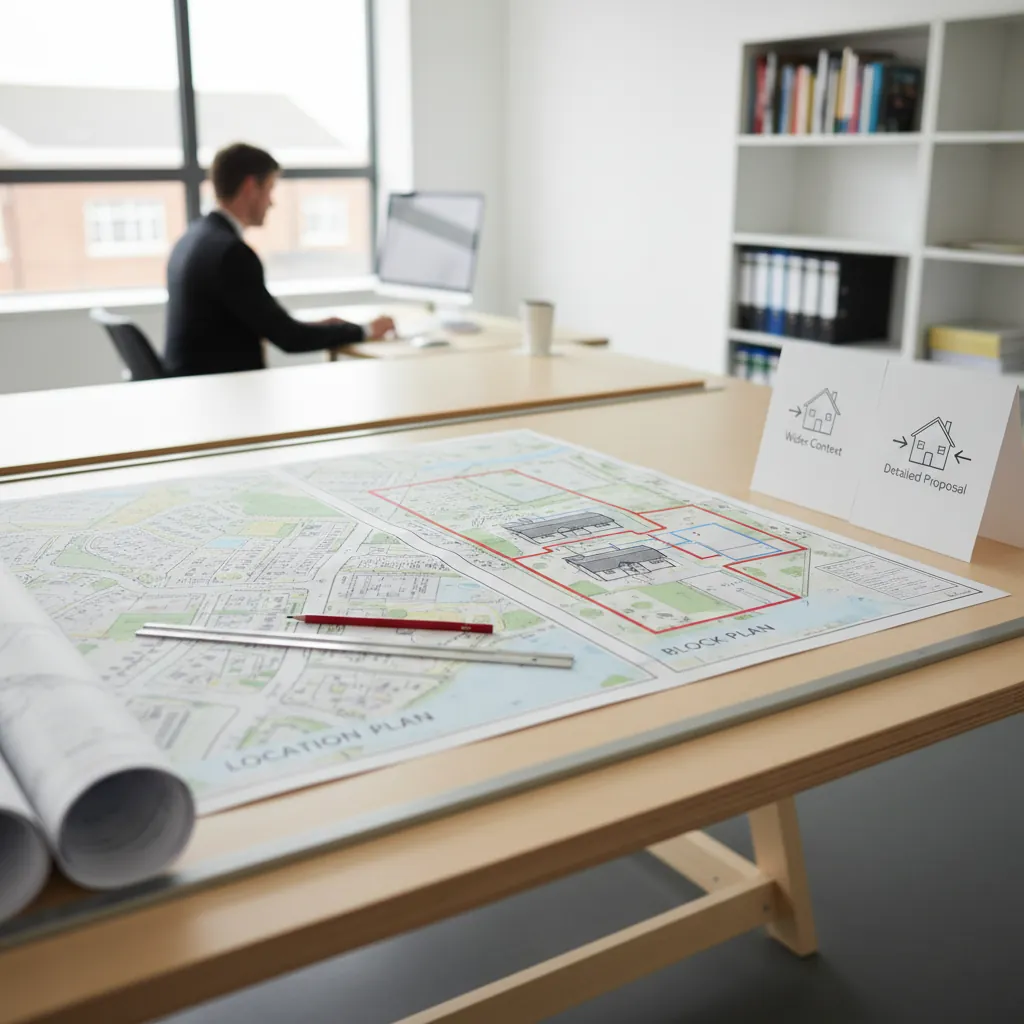
What Does Map Scale Actually Mean?.
How Paper Size Affects Your Map Scale
A map scale is only accurate when viewed at its intended paper size.
If a map specifies "Scale 1:1250 @ A4", that statement is only true when printed or calibrated to an A4 page:
- If you print an A4 PDF onto an A3 sheet without adjusting settings, your printer stretches the geometry to fill the larger sheet. The real-world scale is distorted from 1:1250 to roughly 1:880. A planning officer measuring the sheet with a 1:1250 ruler will record inaccurate numbers.
- Conversely, shrinking an A3 plan to fit an A4 page renders the stated scale equally false.
Recommended Paper Sizes
- Site Location Plans: A4 is almost always ideal. It provides sufficient coverage for urban 1:1250 mapping and is easy to view on standard office screens.
- Block Plans: For compact suburban plots, A4 at 1:500 works well. If you have a larger garden or long driveway that must fit on the 1:500 view, choose A3 so the entire site fits without compromising scale.
Three Scale Traps That Cause Validation Delays
1. "Do Not Scale" Disclaimers on Location Plans
Many architectural and engineering drawing templates include an automatic disclaimer: "Do not scale from this drawing — use figured dimensions only." While sensible for construction detailing, applying this disclaimer to a site location plan will trigger an immediate rejection. Planning officers are legally required to scale from location plans to cross-reference council GIS layers.
2. Omitting the Graphic Scale Bar
Stating "Scale 1:500" in text is not enough. You must include a printed graphic scale bar with clear metric divisions (e.g., 0m, 5m, 10m, 20m). The scale bar acts as a calibration baseline when drawings are inspected digitally on varying monitor sizes.
3. Printing with "Fit to Page" Enabled
When checking a printed proof on your home or office printer, never select "Fit to Page", "Shrink to Printable Area", or "Scale to Fit". Most desktop printers have non-printable margins and shrink the document by 3% to 6% to avoid clipping the edges. Always select "Actual Size" or "100%".
Frequently Asked Questions
What scale should a site location plan be?
Most UK planning authorities require a 1:1250 scale for urban and suburban properties. For larger rural properties, farms, or woodland, a 1:2500 scale is accepted to capture the nearest classified roads.
What scale should a block plan be?
A block plan is typically drawn at 1:500. For very compact urban plots or complex infill developments where inches count, councils may request 1:200.
How many metres does 1cm represent on a 1:1250 map?
On a 1:1250 scale map, 1 centimetre represents 12.5 metres in real life. On a 1:500 scale map, 1 centimetre represents exactly 5 metres.
Can I use a 1:1250 map as my block plan?
No. A 1:1250 map lacks the resolution required for a block plan. It cannot clearly display wall thicknesses, setback dimensions to fences, or tree root protection zones.
What happens if a planning map is printed at the wrong size?
The scale is immediately compromised. If an A4 map is printed with "Fit to Page" enabled, printer margins shrink the map by 3% to 6%, making physical or digital measurements invalid.
Why is a graphic scale bar mandatory on planning maps?
A graphic scale bar allows planning officers to calibrate digital measurement software and physically verify distances with a scale ruler, ensuring accuracy regardless of screen zoom or printing variations.
Getting Your Scales Right First Time
To ensure your planning maps satisfy your council's validation team:
- Provide a 1:1250 Site Location Plan showing neighbourhood context and road access.
- Provide a 1:500 Block Plan demonstrating proposed work and boundary clearances.
- Verify that each map features a graphic metric scale bar, north point, and OS licence statement.
- Always print or export files at 100% actual size.
Our Planning Map Pack provides both the 1:1250 location plan and 1:500 block plan for your address in a single, coordinated order.