
The most common buying mistake in planning mapping is ordering by filename alone. Someone sees "Location Plan" on a council validation checklist, purchases a single 1:1250 PDF, and then receives an invalidation letter because the council also requires a 1:500 block plan. Or they purchase a PDF, only for their architect to ask for a DWG vector file so they can begin drafting.
When searching to buy maps for planning permission, the goal is not just finding the cheapest file online. It is ordering the exact document combination your council validation team and design professionals require, without having to buy twice.
Here is a practical buyer's guide to the specific Ordnance Survey mapping products needed for UK planning applications.
If you want the safest, all-in-one route, explore our Ordnance Survey planning maps pack, which generates your site location plan and block plan together.

Need to buy maps for planning permission?
Which Map Product Do You Actually Need?
Planning mapping purchases fall into four distinct categories:
- Site Location Plan (1:1250 or 1:2500): The wider context map used to identify where the property sits in relation to surrounding roads.
- Block Plan / Site Plan (1:500 or 1:200): The detailed layout map showing the proposed works relative to plot boundaries.
- Planning Map Pack (Combined): Both the location plan and block plan bundled together. This is the standard, safest choice for any building project.
- CAD Planning Maps (DWG / DXF): Raw vector data for architects, surveyors, or civil engineers drafting in AutoCAD, Revit, or Vectorworks.
Product Comparison Matrix
| Product | Best For | Typical Scale | Primary Format | When to Order |
|---|---|---|---|---|
| Site Location Plan | Wider site identification | 1:1250 (urban) / 1:2500 (rural) | Print-ready PDF | Only when the council checklist specifies a location plan without operational building works. |
| Block Plan | Detailed plot proposals | 1:500 (standard) / 1:200 (tight plots) | Print-ready PDF | When physical building works, extensions, or boundary alterations are proposed. |
| Planning Map Pack | Complete homeowner submission | 1:1250 + 1:500 combined | Print-ready PDFs | The recommended default for extensions, lofts, outbuildings, and garages. |
| CAD Planning Maps | Architectural design workflows | 1:1 real-world vector units | DWG or DXF | When your architect or designer explicitly requests editable CAD geometry. |
Detailed Breakdown of Each Product
1. The Site Location Plan
This is the mandatory statutory map that identifies your property on the council's central GIS systems.
- Urban / Suburban: 1:1250 scale on an A4 sheet. Shows the property, immediate neighbours, and at least two named roads.
- Rural: 1:2500 scale. Covers larger acreage, farms, and long private driveways connecting to the nearest classified highway.
- Mandatory Feature: A continuous red line enclosing the plot and extending along the access route to the adopted highway.
2. The Block Plan (Site Plan)
The block plan zooms directly into the plot. At 1:500, planning officers can measure exact setback distances between new extension walls and neighbouring boundaries.
- What it shows: Existing building footprints, proposed works (hatched or shaded), fences, walls, mature trees, hardstanding, and parking.
3. CAD Planning Maps (DWG / DXF)
Unlike static PDFs, CAD files contain raw vector geometry organized into discrete layers (buildings, kerbs, boundaries, watercourses).
- If your architect is designing a full scheme from scratch, supplying an official OS DWG file saves them hours of manual site tracing and prevents dimensional errors.
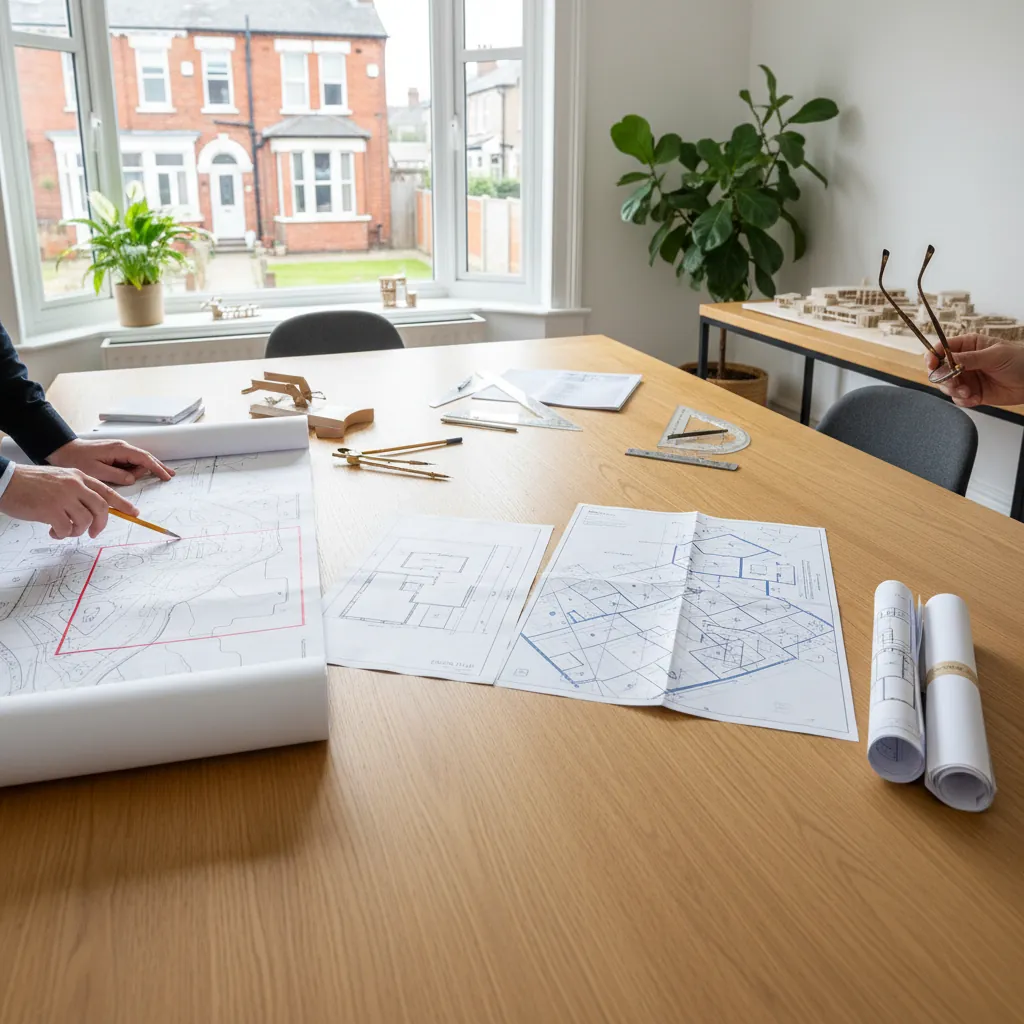
Buyer comparison: which planning map product are you actually after?
The Anatomy of OS MasterMap: What Are You Actually Paying For?
When purchasing an official planning map, you are not buying a simple picture. You are licensing an extract of Great Britain's definitive geospatial database: the Ordnance Survey MasterMap Topography Layer.
Understanding what this dataset contains helps clarify why local planning authorities insist on it over generic consumer mapping:
- Topographic Identifiers (TOIDs): Every building outline, parcel boundary, road edge, and watercourse in MasterMap possesses a unique 16-digit identifier called a TOID. Planning department GIS systems ingest these vectors directly to link your planning application to existing municipal database records.
- Centimetre-Level Positional Accuracy: MasterMap is surveyed to precise national standards: typically ±0.4m root mean square error (RMSE) in urban areas and ±0.9m in rural environments. This high positional accuracy ensures that when you measure a 1.0-metre setback to a side boundary, the council's digital measuring tools confirm the exact same physical distance.
- Continuous Revision Cycle: Ordnance Survey makes thousands of updates every week, capturing new property developments, demolished structures, altered fence lines, and newly adopted highways. Downloading a fresh MasterMap extract ensures your application reflects current ground reality rather than five-year-old aerial satellite imagery.
- Multi-Feature Layering: MasterMap categorizes features into distinct themes: buildings, structures, paths, roads, private tracks, verges, water, and administrative boundaries. In our CAD exports, these themes are partitioned into standard CAD layers, allowing architects to isolate or hide background vegetation and focus on structural walls.
Licensing, Copyright, and Legal Requirements Under UK Law
Why can't you just print a screenshot of Google Maps or scan an old title plan?
- Crown Copyright Infringement: Ordnance Survey data is protected under Crown copyright and database rights governed by the Copyright, Designs and Patents Act 1988. Reproducing mapping for commercial or statutory purposes without a licence is a copyright infringement.
- Mandatory Council Audit Controls: The Planning Portal and municipal planning departments operate automated validation scripts. These systems check for the presence of an authorised OS Partner Licence Number (e.g. PlanningMapsUK's official licence) and copyright statement in the document header or title block. Plans lacking this licence are flagged and rejected before an officer even evaluates the scheme.
- Licence Validity Period: When you purchase an Ordnance Survey map pack through PlanningMapsUK, your licence grants statutory permission to use that mapping across the entire lifespan of that planning application—including pre-application enquiries, full submission, planning appeals, and subsequent Building Regulations applications.
Cost Breakdown: Map Pack vs Surveyor vs CAD
How does the cost of purchasing digital planning maps compare to other survey methods?
| Procurement Route | Typical Cost | Deliverable | Best Suited For | Turnaround Time |
|---|---|---|---|---|
| Online Map Pack (PlanningMapsUK) | £31.95 | 1:1250 Location Plan + 1:500 Block Plan (PDF) | Standard extensions, lofts, garage conversions, dropped kerbs | Instant (under 5 mins) |
| Standalone Location Plan | £20.50 | 1:1250 or 1:2500 PDF | Minor change of use, advertising consent, prior approvals | Instant |
| CAD Vector Extract (DWG/DXF) | £14.95 – £29.95 | Layered 2D/3D CAD vectors | Architects drafting existing and proposed site elevations | Instant |
| Physical Land Survey (Measured Topographical) | £600 – £1,800+ | 3D topographical survey with spot heights | Multi-unit new builds, steeply sloping sites, contested boundaries | 1 to 3 weeks |
For the overwhelming majority of domestic home improvements, purchasing an official digital map pack satisfies 100% of the council's legal requirements at a fraction of the cost of hiring an on-site land surveyor.
Five Common Buying Mistakes to Avoid
- Purchasing a Single Map When You Need Both: Almost every application involving physical construction requires both a 1:1250 location plan and a 1:500 block plan. Buying them as a bundle ensures matching red lines and saves money.
- Confusing Title Plans with Planning Maps: Land Registry title plans show general ownership boundaries, not topographic planning data. Councils reject them at validation.
- Ordering PDF When the Architect Asked for CAD: If an architectural designer is preparing planning drawings, ask them upfront: "Do you need editable DWG files?" Purchasing the CAD file at the start prevents duplicate orders.
- Selecting the Wrong Rural Scale: Ordering a 1:1250 map for an isolated rural property often results in a plan showing only open fields with no road names visible. Rural sites usually require 1:2500.
- Buying from Unaccredited Websites: Make sure your provider is an authorised Ordnance Survey partner displaying official Crown copyright licensing. Without a valid licence code, council validation systems will reject your document.
Frequently Asked Questions About Buying Planning Maps
What maps do I need to buy for planning permission?
For almost all building projects (extensions, outbuildings, new builds), you need a 1:1250 site location plan and a 1:500 block plan. Add CAD (DWG/DXF) only if your architect requests editable vector files.
Is a planning map pack better than buying maps individually?
Yes. A planning pack provides both the 1:1250 location plan and 1:500 block plan centered on the same property with matching red-line boundaries, saving money and eliminating validation mismatches.
When should I buy a site location plan only?
A standalone 1:1250 location plan is typically sufficient for minor changes of use without building works, advertisement consents, or simple boundary adjustments where no detailed site plan is specified.
What is the difference between PDF and CAD planning maps?
PDF maps are static, locked documents formatted for direct upload to the Planning Portal. CAD maps provide editable vector layers in DWG or DXF format for architectural drawing software.
Can I buy official Ordnance Survey planning maps online?
Yes. Authorised OS partners like PlanningMapsUK provide instant online downloads of licensed MasterMap data with scale bars, north points, and copyright blocks.
Summary: Ordering with Confidence
Before placing your order:
- Confirm whether you need the wider location map only or both the location plan and block plan.
- Check whether your plot is urban (1:1250) or rural (1:2500).
- Confirm with your architect whether they require editable CAD data (DWG) or standard PDFs.
Order your compliant Ordnance Survey planning maps on PlanningMapsUK today for immediate download.