
The most expensive planning map mistake is rarely a catastrophic drafting error. It is the friction of buying one map, uploading it to the Planning Portal, having the council issue an invalidation notice requesting a second map, and realising you must now redraw the red-line boundary from scratch on a separate platform.
That is why applicants search for a planning permission map pack. They are not looking for a single isolated PDF—they want a complete, council-compliant set of mapping documents that satisfies local validation criteria, aligns with their architect's drawings, and eliminates guesswork.
If you are preparing a submission now, the safest and most cost-effective route is to order your site location plan and block plan together through our Ordnance Survey planning maps pack. If your architect is drafting the technical package in CAD software, add CAD planning maps to receive native DWG/DXF files.
To quickly determine your exact requirements, use our interactive Which planning map do I need? tool or check our planning map scale chooser.

Need a planning permission map pack?
What Documents Make Up a Planning Permission Map Pack?
A standard, council-ready planning map pack bundles two distinct but complementary statutory drawings:
- The Site Location Plan (1:1250 or 1:2500 Scale): Shows the property within its wider geographic context, displaying at least two named roads and showing how the site connects to the public highway network.
- The Block Plan / Site Plan (1:500 or 1:200 Scale): Focuses closely on the property curtilage, detailing existing and proposed building footprints, boundary fences, access points, and clearances to neighbouring structures.
For architect-led schemes, the pack can be upgraded to include:
- Vector CAD Data (DWG / DXF): Raw Ordnance Survey MasterMap linework layered for AutoCAD, Revit, and Vectorworks.
A map pack is not a random collection of documents. It is a synchronized pair of drawings that answers two distinct validation requirements while sharing identical site geometry and licensing.
Pack Selection Matrix: Which Bundle Do You Need?
| Package Option | Best For | Included Plans | Key Risk of Buying Incomplete Plans |
|---|---|---|---|
| Location Plan Only (1:1250 PDF) | Simple change of use without physical building work | 1:1250 A4/A3 Location Plan | Council invalidates application asking for a 1:500 block plan |
| Standard Planning Pack (PDF) | Extensions, loft dormers, outbuildings, dropped kerbs, LDCs | 1:1250 Location Plan + 1:500 Block Plan | None. This is the statutory standard for 90% of UK home applications |
| Planning Pack + CAD (PDF + DWG) | Architect-, designer-, or engineer-led renovations and new builds | 1:1250 & 1:500 PDFs + full DWG/DXF vector files | Architect charges extra to manually trace or order CAD separately |
| Rural / Large Site Pack | Farms, barn conversions, rural plots with private drives | 1:2500 Location Plan + 1:500 Block Plan | Standard 1:1250 map crops out highway access or road names |
Why Bundling Outperforms Buying Single Maps
1. Eliminates Boundary Discrepancies
When you purchase a location plan from one website and a block plan from another, slight differences in map centering, line thickness, or digital snapping can produce mismatched red lines. Validation officers will pause the application until both boundaries match identically. A bundled pack draws both plans from a single boundary session.
2. Guarantees Identical Ordnance Survey Epochs
Ordnance Survey updates MasterMap daily. Generating both maps simultaneously ensures both files share identical copyright timestamps and survey features, preventing discrepancies during council GIS ingestion.
3. Substantial Cost Savings
Purchasing a 1:1250 location plan (£20.50) and a 1:500 block plan separately costs more than our combined Planning Map Pack (£31.95), saving money while ensuring guaranteed compliance.
Statutory Basis: Why Councils Demand Dual-Plan Submissions
Many first-time applicants wonder why local planning authorities insist on receiving two separate maps rather than one compromise drawing. The answer lies in the legal division of statutory planning powers:
- National Legal Requirement (Article 7 DMPO 2015): The Town and Country Planning (Development Management Procedure) (England) Order 2015 Article 7 mandates that every application must include "a plan which identifies the land to which the application relates, drawn to an identified scale and showing the direction of North". This is the Site Location Plan. It is a national statutory requirement that no council has the legal authority to waive.
- Local Validation Requirements (Section 62 TCPA 1990): Under Section 62 of the Town and Country Planning Act 1990, councils publish Local Validation Lists detailing additional particulars required for registration. Virtually all 300+ English and Welsh LPAs legally require a Block Plan (Site Plan) at 1:500 or 1:200 for any development involving building operations.
- The Legal Consequence of Mismatched Boundaries: Planning case law confirms that an inconsistency between the red-line boundary on the 1:1250 location plan and the 1:500 block plan renders an application legally defective. If the location plan includes a private driveway but the block plan crops it out, the council cannot grant a valid planning permission because the physical limits of the development site are ambiguous. A bundled map pack guarantees that both drawings share the identical digital polygon.
Choosing Sheet Sizes: A4 vs A3 for Map Packs
While standard suburban properties fit comfortably onto standard A4 sheets, selecting the wrong paper size can result in cramped or illegible drawings:
| Project Type | Location Plan (1:1250) | Block Plan (1:500) | Recommended Sheet Size | Why It Matters |
|---|---|---|---|---|
| Typical Terraced / Semi-Detached House | 1:1250 @ A4 | 1:500 @ A4 | Standard A4 Pack | The property footprint, front drive, and rear garden fit neatly within the printable frame while showing two neighbouring streets. |
| Detached House with Large Plot (>0.25 acres) | 1:1250 @ A4 or A3 | 1:500 @ A3 | A3 Upgrade | A standard A4 sheet at 1:500 covers roughly 100m x 70m on the ground. A wide garden or long driveway will be clipped unless expanded to A3. |
| Rural Holding or Smallholding | 1:2500 @ A4 or A3 | 1:500 @ A3 | Rural Pack (A3) | The 1:2500 location view captures the nearest public road, while the A3 1:500 view accommodates agricultural outbuildings and yards. |
| Commercial Yard or Infill Development | 1:1250 @ A3 | 1:200 or 1:500 @ A3 | Large Site Pack | Displays multi-vehicle turning heads, loading bays, refuse access, and visibility splays without visual crowding. |
PlanningMapsUK automatically previews your chosen paper size so you can visually confirm that no part of your red-line boundary touches the margin frame before completing your order.
10-Point Pre-Submission Quality Audit
Before uploading your map pack documents to the Planning Portal, run through this 10-point checklist used by professional planning technicians:
- Licence Verification: Does the title block clearly display a valid Ordnance Survey Crown copyright licence string?
- True North Orientation: Does the North arrow point vertically towards the top of the sheet on both plans?
- Dual Named Roads: Are at least two named streets visible on the 1:1250 location plan to locate the site within the wider neighbourhood?
- Continuous Red Boundary: Does the red line form an unbroken closed loop encompassing the house, garden, and driveway out to the public adopted road?
- Boundary Concordance: Does the red-line outline on the 1:500 block plan match the 1:1250 location plan precisely?
- Blue Line Accuracy: If the applicant owns adjacent land (such as an adjoining meadow or neighbouring rental house), is it outlined in continuous blue?
- Scale Bar Calibration: Does each sheet feature a metric graphic scale bar (showing metres, not imperial feet)?
- Scale Statement: Does the drawing declare both the ratio and paper size (e.g. "Scale 1:500 at A4" or "Scale 1:1250 at A4"), and warn against scaling off altered copies?
- Uncompressed Vector PDF: Is the file saved in native vector PDF format (preserving sharp linework when zoomed to 400%)?
- File Size Check: Is the file size optimized (under 5MB) for seamless upload to the Planning Portal without upload timeouts?
What Each Document in the Pack Delivers
The Site Location Plan (1:1250)
- Primary Function: Informs the council's central GIS where the property is located.
- Key Features: True North arrow, metric graphic scale bar, OS Crown copyright licence, two named roads, continuous red application boundary leading to the public highway.
The Block Plan (1:500)
- Primary Function: Demonstrates how the proposed building work interacts with plot boundaries.
- Key Features: Dimensions from proposed walls to garden boundaries, existing building footprints, position of public footpaths, access gates, and parking bays.
Vector CAD Layers (DWG/DXF)
- Primary Function: Provides editable CAD layers for architects and structural engineers.
- Key Features: Layered building outlines, road curbs, contours, and physical features ready for 3D modeling and working construction drawings.
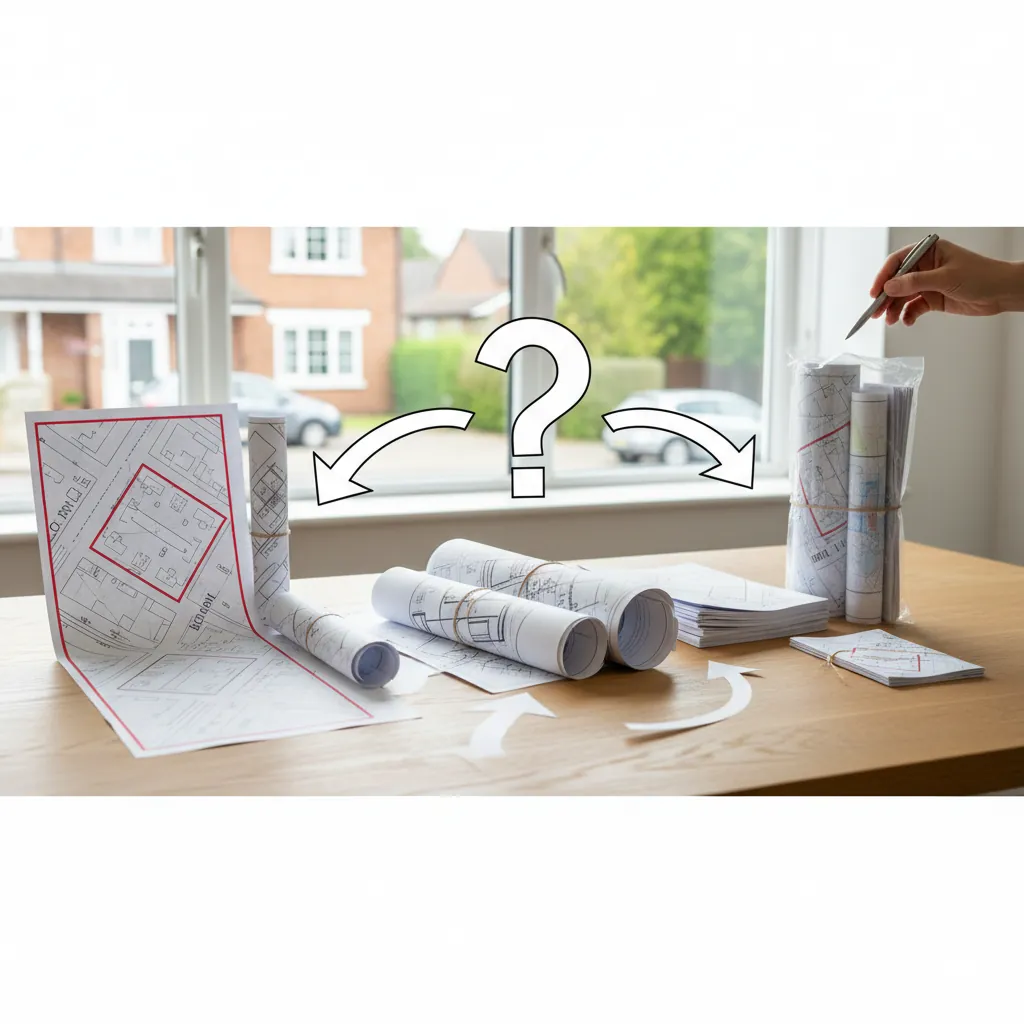
Pack comparison: which route fits your project?
When Should You Add CAD to Your Pack?
You should add CAD planning maps whenever:
- Your architect, surveyor, or architectural technologist requests a DWG or DXF file.
- The project involves a complex multi-storey extension, basement, or new-build dwelling.
- You want your design team to work directly from official OS vector coordinates rather than tracing over a raster PDF.
If you are submitting a straightforward homeowner application yourself using the Planning Portal and do not use CAD software, the Standard PDF Map Pack is all you need.
Frequently Asked Questions
What is included in a planning permission map pack?
A standard planning map pack includes an Ordnance Survey 1:1250 site location plan showing wider neighbourhood context and an OS 1:500 block plan detailing the immediate property boundaries and building footprints.
Do I always need both a location plan and a block plan?
Yes, for virtually all applications involving physical construction, extensions, outbuildings, or access alterations. The location plan identifies the legal parcel, while the block plan provides the measurable site layout.
Is CAD mapping automatically included in a planning map pack?
Standard map packs are delivered as high-resolution, print-ready PDF files. Vector CAD formats (DWG or DXF) are optional add-ons typically requested by architects, structural engineers, or planning consultants.
Which map pack scale should I choose for a rural property?
Rural properties, farms, or homes with private access tracks longer than 100 metres should choose a 1:2500 location plan paired with a 1:500 block plan to ensure surrounding road junctions are visible.
Why is buying a bundled map pack better than ordering plans individually?
Bundling both plans ensures your red-line application boundary is identical across both documents, uses the exact same Ordnance Survey MasterMap release date, and costs less than purchasing separate maps.
Can I submit a planning application without a block plan?
Only for very specific minor proposals that involve no operational building work (such as simple changes of use within an existing commercial unit). All extensions, new builds, and external alterations require a block plan.
Summary
When ordering your planning maps:
- Choose the Standard Planning Map Pack (1:1250 Location + 1:500 Block Plan) for domestic extensions, loft conversions, and outbuildings.
- Choose the Rural Planning Pack (1:2500 + 1:500) for expansive sites, farms, or properties with long private drives.
- Add DWG CAD mapping if an architect or design team is preparing the technical drawing set.
Order your official planning permission map pack on PlanningMapsUK today with instant PDF download.