
The enquiry usually starts with a simple frustration: "The standard map does not show enough of our site." It comes from rural homeowners, small developers, agricultural landowners, or anyone dealing with a long private access track that stretches far beyond a standard suburban plot.
Searchers describe this need in various ways. Some ask for large scale maps UK, others specifically search for a 1:2500 planning map, and many simply need a larger sheet format that captures their driveway connecting to the nearest public road. The underlying issue is identical: the default suburban 1:1250 A4 layout cannot accommodate the geography of the site.
This guide clarifies how to choose the right map scale, sheet size, and data format for expansive, rural, or complex properties. If you need compliant mapping immediately, browse our Ordnance Survey planning maps or generate a site location plan at 1:1250 or 1:2500 scale.

Need large scale maps in the UK for a planning application?
What Do Applicants Mean by "Large Scale Maps UK"?
In formal cartography, "large scale" means a map that shows features close up with high precision, such as a 1:500 block plan. However, in practical planning conversations, property owners usually mean one of three things:
- They need a map that covers more land area.
- They need a map that shows wider geographic context (such as road junctions and hamlets).
- They need a format suited for a rural holding, agricultural parcel, or commercial site.
The challenge is rarely cartographic theory—it is selecting the exact combination of scale (1:1250 vs 1:2500), paper size (A4 vs A3), and file type (PDF vs CAD) that satisfies council validation officers on the first attempt.
Quick Reference: Matching Your Site to the Right Map
| Situation | Best Starting Point | Why It Works | When to Add CAD |
|---|---|---|---|
| Standard urban / suburban plot | 1:1250 location plan + 1:500 block plan | Provides standard statutory context and layout detail | Only if designer requests raw vector lines |
| Rural house with long driveway | 1:2500 location plan + 1:500 block plan | Captures the entire private track out to the public highway | If laying out complex drainage or tracks |
| Multi-parcel or smallholding | 1:2500 A3 location plan + 1:500 block plan | Prevents awkward cropping while showing surrounding fields | Recommended for multi-building master plans |
| Architect- or consultant-led scheme | 1:1250 / 1:2500 PDF + DWG CAD pack | Provides statutory submission PDFs and editable design files | Essential for CAD drafting in AutoCAD/Revit |
| Commercial yard or industrial unit | 1:1250 or 1:2500 depending on frontage | Balances yard boundaries with road access | Highly recommended for logistics and tracking layouts |
When 1:1250 Is Too Tight
For standard semi-detached or terraced houses, 1:1250 on A4 is the gold standard. It clearly frames the house, gardens, and immediate streetscape. However, 1:1250 breaks down when:
- The dwelling sits hundreds of metres back from the nearest council-maintained road.
- Access relies on a private shared track across multiple ownership parcels.
- The property forms an elongated smallholding or woodland plot.
- The nearest named road junction sits outside the printable A4 map window.
- The application encompasses multiple agricultural barns spread over hectares.
In these situations, forcing a 1:1250 scale results in an over-cropped map where validation officers cannot determine where the land connects to the public road network.
Why 1:2500 Is the Established Rural Standard
Under UK government validation guidelines, 1:2500 scale is officially recognized for larger or rural planning submissions. It halves the linear scale, allowing four times the land area to be displayed on the same sheet of paper.
A 1:2500 location plan gives the planning officer vital context:
- The full length of access driveways leading to the adopted highway.
- Surrounding agricultural land, woodlands, and adjacent farmsteads.
- Key local landmarks, named country lanes, and orientation points.
- Sufficient room to illustrate adjoining blue-line ownership land.
Crucial distinction: Moving to a 1:2500 location plan does not exempt you from providing a detailed 1:500 block plan. The location plan establishes wider context; the block plan details the precise construction footprint, clearances, and proposed eaves.
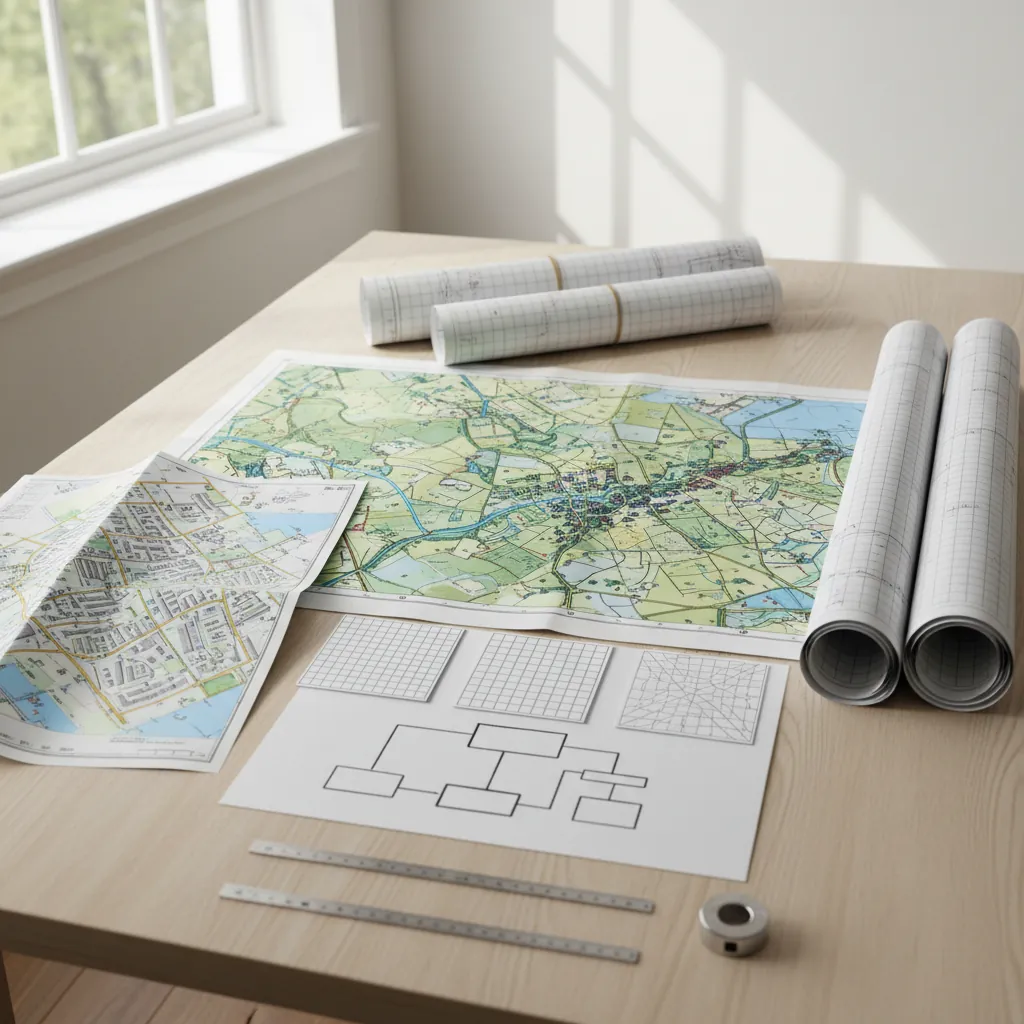
Quick matrix: what should you choose?
Choosing Between A4, A3, and CAD Formats
When an applicant says their map feels cramped, they may need a larger sheet size rather than a smaller map scale.
1. Change Scale (1:1250 to 1:2500) When Context Is Missing
If the map fails to show surrounding road junctions or neighbouring properties required for basic orientation, change the scale from 1:1250 to 1:2500.
2. Change Sheet Size (A4 to A3) When Detail Feels Crowded
If 1:1250 is the correct scale for your site but the boundary edges are clipped by an A4 margin, upgrade to an A3 PDF. An A3 sheet doubles the visible surface area while maintaining the crisp 1:1250 scale.
3. Choose CAD When the Design Is Evolving
If you are working with an architect, structural engineer, or planning agent, order CAD planning maps in DWG or DXF format:
- Architects import the OS MasterMap linework straight into AutoCAD, Revit, or Vectorworks.
- Ground levels, proposed extensions, and vehicle turning circles can be drawn directly on licensed survey lines.
- It eliminates the need for manual tracing and guarantees millimeter-level boundary alignment.
Ground Coverage Reference Table: How Much Land Fits on Each Sheet?
To remove all guesswork when choosing paper size and scale, consult this real-world ground coverage matrix:
| Scale Ratio | Sheet Size | Printable Ground Width (m) | Printable Ground Height (m) | Total Ground Area (Hectares / Acres) | Typical Project Suitability |
|---|---|---|---|---|---|
| 1:200 | A4 | ~42 metres | ~30 metres | ~0.12 ha (0.3 acres) | Very tight urban infill, single terraced house plot, mews extensions |
| 1:200 | A3 | ~70 metres | ~50 metres | ~0.35 ha (0.86 acres) | Complex multi-bay urban parking layouts, small courtyard developments |
| 1:500 | A4 | ~105 metres | ~75 metres | ~0.78 ha (1.9 acres) | Standard suburban semi-detached house, front drive, and 50m rear garden |
| 1:500 | A3 | ~175 metres | ~125 metres | ~2.18 ha (5.4 acres) | Detached executive home, corner plots, large gardens with outbuildings |
| 1:1250 | A4 | ~260 metres | ~185 metres | ~4.81 ha (11.9 acres) | Urban/suburban location plan showing two named roads and neighbours |
| 1:1250 | A3 | ~440 metres | ~310 metres | ~13.6 ha (33.6 acres) | Large residential plots, suburban cul-de-sacs, small rural paddocks |
| 1:2500 | A4 | ~525 metres | ~370 metres | ~19.4 ha (47.9 acres) | Rural smallholdings, barn conversions with 300m private farm driveways |
| 1:2500 | A3 | ~880 metres | ~620 metres | ~54.5 ha (134.6 acres) | Large rural estates, commercial distribution parks, equestrian centers |
If your property boundary or private access road exceeds 260 metres in physical length, it is physically impossible to display it on an A4 sheet at 1:1250 scale without either switching to A3 or moving to 1:2500.
Agricultural Prior Notifications: Mapping for Farms (Part 6 GPDO)
A significant percentage of rural mapping orders involve agricultural permitted development under Schedule 2, Part 6 of the GPDO 2015:
- Class A (Agricultural Holdings of 5 Hectares or More): Permits agricultural sheds, grain stores, and machinery barns up to 1,000 square metres in ground area. The statutory prior notification submission must include a 1:2500 location plan clearly displaying the boundary of the agricultural unit and proving that the proposed building sits at least 400 metres away from the curtilage of any protected protected residential building (excluding farmworkers' cottages).
- Class B (Holdings Between 0.4 and 5 Hectares): Permits smaller extensions or agricultural buildings up to 20 hectares in ground area, requiring precise distance measurements to classified roads and public footpaths.
- Agricultural Access Tracks: Creating or engineering a new farm track under Class A requires a 1:2500 map tracing the entire length of the track from the agricultural parcel out to the classified highway, demonstrating appropriate vehicle visibility splays at the road junction.
Advanced Spatial Formats for Rural Land Agents (GIS Data)
For larger agricultural estates, land agents and forestry managers often require data formats beyond standard PDF or CAD:
- GeoPackage (GPKG) & ESRI Shapefiles (SHP): Open and proprietary spatial GIS formats that allow rural managers to load OS MasterMap directly into QGIS or ArcGIS.
- Land Management Overlays: GIS formats enable land agents to overlay Rural Payments Agency (RPA) land parcel identifiers, Defra Environmental Land Management schemes (ELMs), Countryside Stewardship field boundaries, and Forestry Commission felling licences onto official topographic data.
Key Pitfalls on Larger and Rural Planning Sites
- Forcing rural sites onto an A4 1:1250 frame: If the access track cannot reach the public highway within the map borders, the application will be invalidated.
- Omitting the 1:500 block plan: A 1:2500 map proves where the site is, but officers still need a 1:500 plan to assess privacy, sunlight, and boundary clearances.
- Overlooking shared private rights of way: If your rural drive crosses third-party land, that entire track must be edged in red and accompanied by an ownership Certificate B notice.
- Ordering raster image files instead of CAD: For larger developments, design teams require vector layers (DWG/DXF), not flattened JPEGs or scanned PDFs.
Frequently Asked Questions
What does "large scale maps UK" usually mean for planning applications?
While cartographers define large scale as close-up detail, planning applicants usually mean they need a map covering a larger land parcel, rural plot, or long private driveway. In practice, this means choosing a 1:2500 location plan, an A3 paper size, or vector CAD data.
When should I choose 1:2500 instead of 1:1250?
Choose 1:2500 when a standard 1:1250 sheet cannot fit your full property boundary, its access route to the adopted highway, and at least two named roads required by validation officers.
Do larger rural sites still need a 1:500 block plan?
Yes. The 1:2500 location plan establishes geographic context, but planning officers still require a 1:500 or 1:200 block plan showing the immediate proposal footprint, tree canopies, and boundary clearances.
Is A3 better than A4 for large planning maps?
An A3 sheet provides twice the physical area at the same metric scale, preventing your plot from being awkwardly clipped while retaining crisp 1:1250 or 1:2500 detail.
When should I order CAD mapping instead of a PDF?
Order DWG or DXF CAD mapping when an architect, structural engineer, or planning consultant needs to import real-world OS MasterMap geometry directly into AutoCAD, Revit, or Vectorworks.
Summary
When ordering planning maps for rural or expansive sites, match your map selection to the land:
- Choose 1:1250 on A4 or A3 for standard residential plots.
- Switch to 1:2500 for rural properties, agricultural holdings, and long access drives.
- Always pair your location plan with a 1:500 block plan for the immediate build area.
- Provide your architect with DWG CAD mapping if they are designing detailed technical drawings.
Order your council-compliant Ordnance Survey planning maps or generate your site location plan today on PlanningMapsUK.